


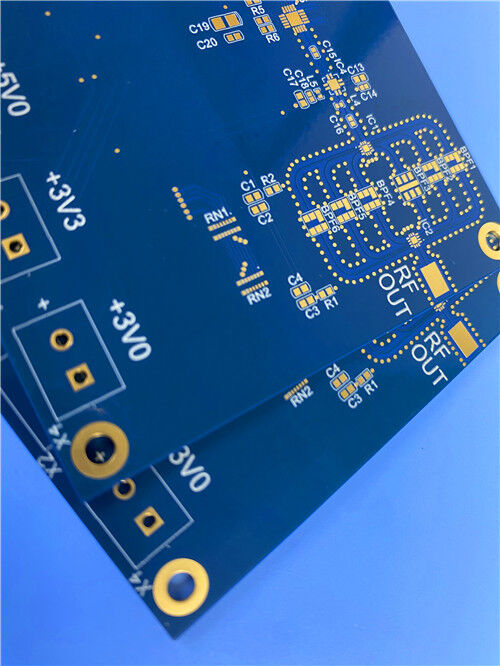
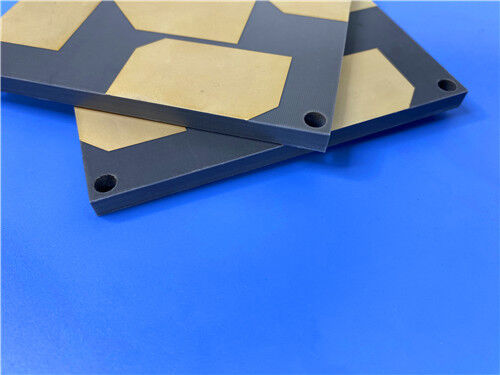
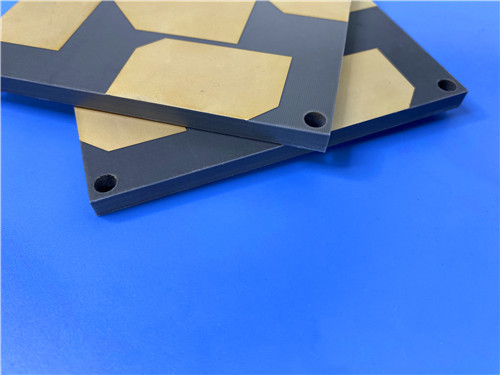
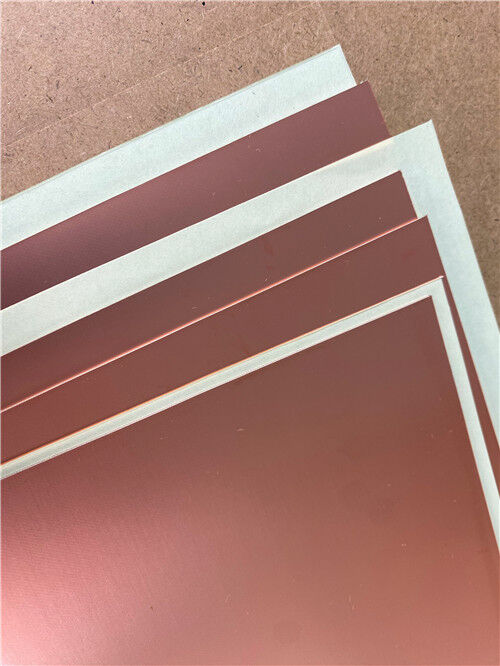
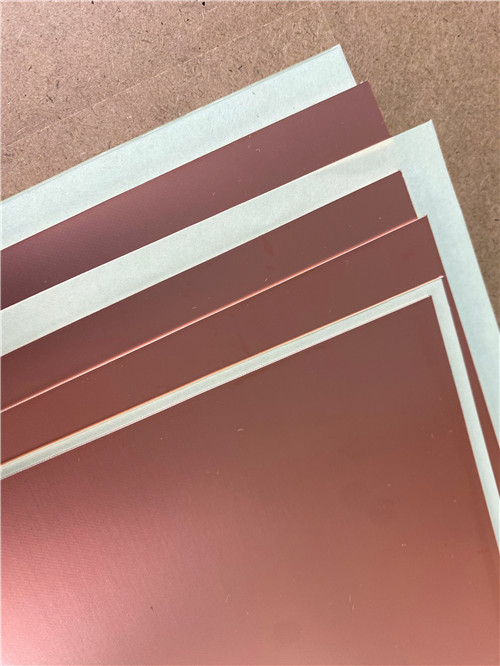

Rogers RO4450F Bondply be used for 8-Layer copper weight Mixed-Material PCB that 4mil RO4350B + TG170 FR-4 + 8mil RO4003C
Contact Person : Sally Mao
Phone Number : 86-755-27374847
WhatsApp : +8618277967574
| Brand Name: | Rogers | Model Number: | RO3003 + Isola 370HR |
|---|
Product Description
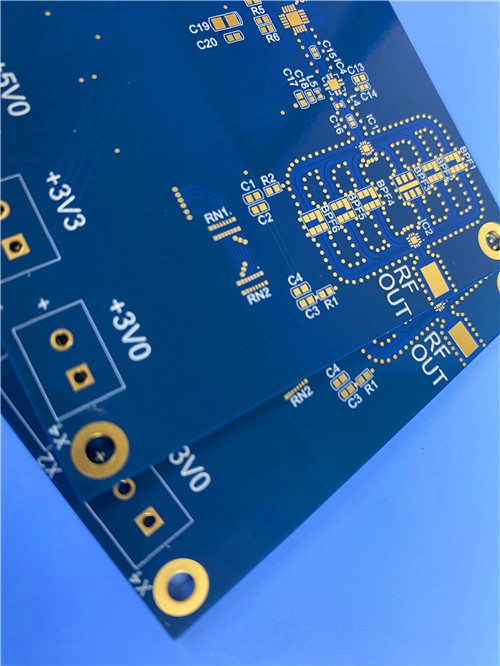
This article presents a detailed design strategy for a 6-layer hybrid PCB that combines the superior high-frequency performance of Rogers RO3003™ with the excellent thermal reliability and cost-effectiveness of Isola 370HR FR-4. This hybrid construction is ideal for demanding RF/microwave applications requiring controlled impedance, blind vias, and reliable thermal management in a compact form factor.
By integrating RO3003 as the high-frequency material and 370HR as the bonding/prepreg layers, this design achieves an optimal balance of electrical performance, mechanical robustness, and manufacturability for small-to-medium-sized RF modules.
Rogers RO3003™ High-Frequency Laminate
RO3003™ is a ceramic-filled PTFE composite laminate from Rogers Corporation’s RO3000® series, designed for commercial microwave and RF applications. This material offers exceptional electrical and mechanical stability at competitive prices.
Key Features:
Key Specifications (RO3003):
| Property | Typical Value | Unit | Test Condition |
| Dielectric Constant (Dk) | 3.00 ± 0.04 | — | 10 GHz / 23°C |
| Dissipation Factor (Df) | 0.001 | — | 10 GHz / 23°C |
| TCDk | -3 | ppm/°C | -50 to 150°C / 10 GHz |
| CTE – X axis | 17 | ppm/°C | -55 to 288°C |
| CTE – Y axis | 16 | ppm/°C | -55 to 288°C |
| CTE – Z axis | 25 | ppm/°C | -55 to 288°C |
| Thermal Conductivity | 0.5 | W/(m·K) | 50°C |
| Moisture Absorption | 0.04 | % | D48/50 |
| Density | 2.1 | g/cm³ | 23°C |
| Flammability | V-0 | — | UL 94 |
| Lead-Free Process Compatible | Yes | — | — |
Isola 370HR High-Performance FR-4
370HR is a high-performance 180°C glass transition temperature (Tg) FR-4 system designed for multilayer Printed Wiring Board (PWB) applications where maximum thermal performance and reliability are required. 370HR laminate and prepreg products are manufactured with a unique high-performance multifunctional epoxy resin, reinforced with electrical grade (E-glass) glass fabric.
Key Features:
Key Specifications (370HR):
| Property | Typical Value | Unit | Test Method |
| Glass Transition Temperature (Tg) | 180 | °C | IPC-TM-650 (DSC) |
| Decomposition Temperature (Td) | 340 | °C | ASTM D3850 |
| T260 | 60 | Minutes | ASTM D3850 |
| T288 | 30 | Minutes | ASTM D3850 |
| CTE – Z-axis (Pre-Tg) | 45 | ppm/°C | — |
| CTE – X,Y axes (Pre-Tg) | 13/14 | ppm/°C | — |
| Z-axis Expansion (50–260°C) | 2.8 | % | — |
| Thermal Conductivity | 0.4 | W/m·K | — |
| Dk @ 1 GHz | 4.17 | — | IPC-TM-650 2.5.5.9 |
| Df @ 1 GHz | 0.0161 | — | IPC-TM-650 2.5.5.9 |
| Moisture Absorption | 0.15 | % | — |
| Flammability | V-0 | Rating | UL 94 |
Design Strategy: Performance Advantages of the Hybrid Stackup
Argument 1: Balancing RF Performance and Cost
RO3003 offers a low dielectric constant (Dk 3.00) and ultra-low dissipation factor (Df 0.0010 at 10 GHz), making it ideal for RF and microwave signal transmission while minimizing high-frequency insertion loss. The 5mil thin dielectric layer allows for precise control of differential and single-ended impedance.
370HR is a high-Tg, heat-resistant prepreg that provides excellent resistance to delamination and withstands multiple SMT reflow cycles. This addresses the poor thermal stability and high costs associated with boards made entirely of ceramic-based materials.
Hybrid Construction Logic:
RF Signal Layers: Use RO3003 for critical high-frequency signal layers (L1, L3, L6) to maintain low loss and stable Dk.
Bonding Layers: Use 370HR prepreg for bonding the RO3003 cores, providing reliable mechanical connection and thermal stability.
Inner Layers: Use 370HR for power/ground planes and digital signal routing, leveraging its cost-effectiveness and FR-4 process compatibility.
Cost Consideration: Hybrid stackups place Rogers on the RF signal layers and FR-4 on digital/power layers, reducing cost by 40–60% versus all-Rogers construction while maintaining RF performance. The bonding layer (370HR prepreg) must be selected for compatible Dk and processing temperature.
Argument 2: Process Control for 0.82mm-Thick 6-Layer Hybrid PCBs
Thickness Control
Precise control of the total board thickness (0.82mm) is achieved through the specific combination of 5mil ceramic dielectric and 5mil 370HR prepreg (PP), adhering to strict thickness tolerance standards.
Stackup Design:
Note: The exact prepreg thicknesses are optimized to achieve the target finished thickness of 0.82 mm.
CTE Mismatch Management
Given the difference in the Coefficient of Thermal Expansion (CTE) between RO3003 and 370HR, specialized multi-stage lamination heating profiles and anti-delamination process strategies are employed.
CTE Comparison:
RO3003: X/Y = 17/16 ppm/°C, Z = 25 ppm/°C
370HR: X/Y = 13/14 ppm/°C (Pre-Tg), Z = 45 ppm/°C (Pre-Tg)
The Z-axis CTE mismatch is significant (RO3003: 25 ppm/°C vs. 370HR: 45 ppm/°C). To manage this, the lamination process should use:
Slow ramp rates in the critical Tg region (150–200°C)
Extended dwell time at peak temperature to allow stress relaxation
Controlled cooling to prevent warpage
Addressing Thin 6-Layer Board Defects
Potential defects in thin 6-layer boards include lamination misalignment and warpage. Root-cause analysis and corrective measures include:
| Defect | Root Cause | Corrective Measure |
| Lamination Misalignment | Uneven pressure, CTE mismatch | Precision tooling pins, optimized press cycle |
| Warpage | Asymmetric stackup, CTE mismatch | Symmetric construction, balanced copper distribution |
| Delamination | Insufficient prepreg flow, contamination | Proper prepreg selection, controlled environment |
| Via Barrel Cracking | Z-axis CTE mismatch | Resin-filled vias, optimized drill parameters |
Blind Vias (Layers 1–2)
Blind vias (L1–L2) reduce via stub effects and improve high-frequency performance by eliminating unnecessary via lengths.
This is critical for maintaining signal integrity in high-layer-count designs.
Implementation: Sequential lamination is required. The first lamination step bonds L1–L2 (RO3003 core), followed by the second lamination step to bond the remaining layers.
Conductive Copper Paste Vias (0.15mm)
The 0.15mm vias are plugged with conductive copper paste. This technology involves filling the through-holes with a via paste containing Cu particles and a curable resin component.
Advantages of Conductive Paste Vias:
Processing Considerations:
PCB Construction Details
| Parameter | Specification |
| Base Material (High-Frequency Layers) | Rogers RO3003 (5 mil) |
| Bonding Material (Prepreg) | Isola 370HR (5 mil) |
| Number of Layers | 6 |
| Finished Board Size | 83 mm × 42 mm (1 piece) |
| Finished Board Thickness | 0.82 mm |
| Outer Layer Copper Weight | 1 oz (35 μm) |
| Inner Layer Copper Weight | 0.5 oz (18 μm) |
| Surface Finish | ENIG (Electroless Nickel Immersion Gold) |
| Top Solder Mask | Blue |
| Bottom Solder Mask | Blue |
| Top Silkscreen | White |
| Bottom Silkscreen | White |
| Blind Vias | L1–L2 |
| Via Plugging | 0.15mm vias, conductive copper paste |
| Electrical Testing | 100% prior to shipment |
| Accepted Quality Standard | IPC-Class-2 |
| Artwork Format | Gerber RS-274-X |
| Global Availability | Worldwide shipping |
Features & Benefits Summary
| Feature | Benefit |
| Hybrid RO3003 + 370HR Construction | Optimizes high-frequency performance and cost-effectiveness |
| 6-Layer Design | Supports complex RF/microwave circuits with power/ground planes |
| 5mil RO3003 Core | Precise impedance control for 50Ω and differential signals |
| 370HR Prepreg (Tg 180°C) | High thermal reliability, multiple reflow capable |
| Blind Vias (L1–L2) | Reduces stub effects, improves signal integrity |
| Conductive Copper Paste Vias | Enables 0.15mm micro-vias, increases routing density |
| ENIG Surface Finish | Flat, solderable, wire-bondable, and corrosion-resistant |
| Blue Solder Mask / White Silkscreen | Comprehensive protection with clear component identification |
| 0.82mm Finished Thickness | Optimized for compact RF module designs |
| 100% Electrical Testing | Guaranteed quality and performance |
| IPC-Class-2 | Meets industry-standard quality requirements |
Typical Applications
This 6-layer hybrid PCB is ideal for a wide range of high-performance applications:
Conclusion
As a specialized supplier of custom high-frequency circuit boards, we combine the proven performance of Rogers RO3003 (low loss, stable Dk, excellent dimensional stability) and Isola 370HR (high Tg, excellent thermal reliability, best-in-class sequential lamination) with our precision manufacturing capabilities to deliver world-class hybrid PCB solutions.
The 6-layer hybrid offering fully leverages RO3003’s low-loss high-frequency performance and 370HR’s thermal reliability and processing advantages, while incorporating advanced features such as blind vias (L1–L2) and conductive copper paste vias (0.15mm) to ensure optimal signal integrity and reliability in a compact 0.82mm form factor.
Whether you are developing automotive radar modules, phased array antennas, or 5G mmWave infrastructure, our engineering team is ready to support your project. For technical consultations, samples, or volume orders, please contact us today.
Enter Your Message

RO4350B, 4003C; Rogers 5880, 5870, 6002, 6010, 6006, 6035; RO3003, RO3035, RO3006, RO3010, RO3210,RO3203
TLX-8, TLX-6, TLX-9, TLX-0, TLX-7, TLY-3, TLY-5, RF-35TC, RF-60TC, RF-35A2, RF-60A, AD450, AD600, TMM4, TC350
| Shenzhen Bicheng Electronics Technology Co., Ltd |
| 6-11C Shidai Jingyuan Fuyong Town, Baoan District, Shenzhen City, Guangdong Province, China |
| 86-755-27374946 |
| sales30@bichengpcb.com |