


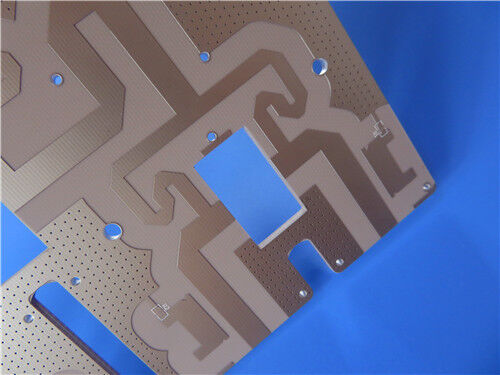
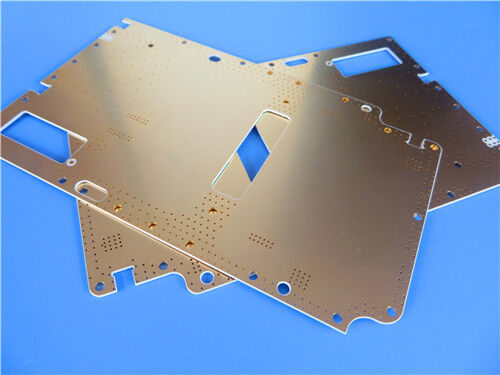
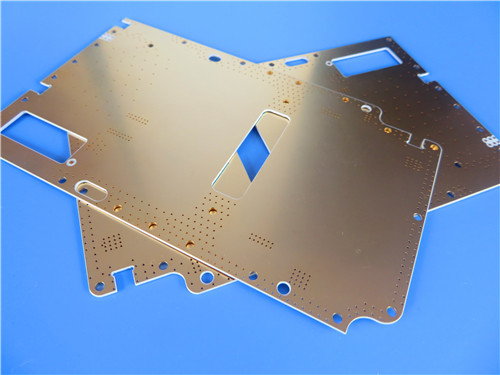
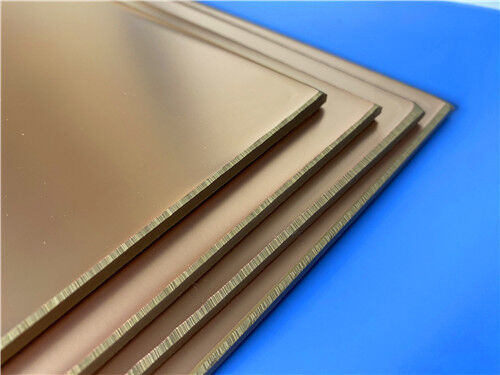
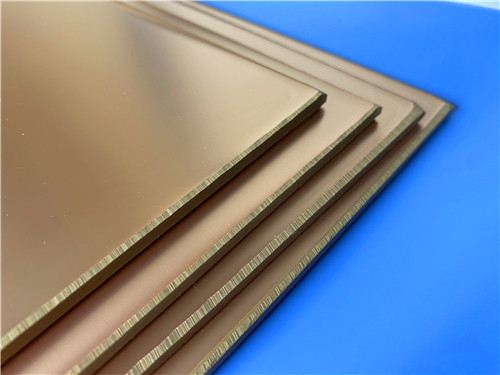

Rogers RO4450F Bondply be used for 8-Layer copper weight Mixed-Material PCB that 4mil RO4350B + TG170 FR-4 + 8mil RO4003C
Contact Person : Sally Mao
Phone Number : 86-755-27374847
WhatsApp : +8618277967574
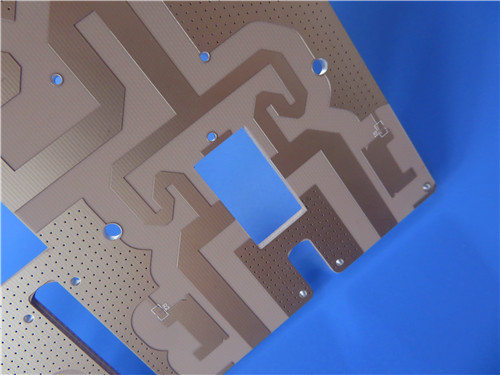
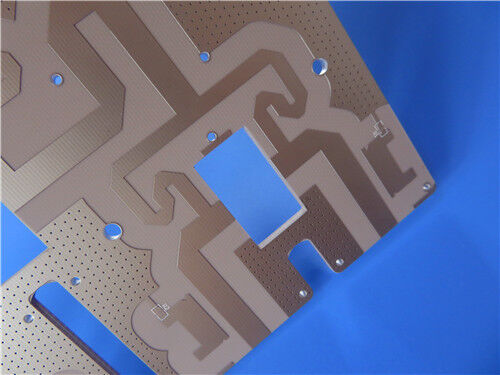
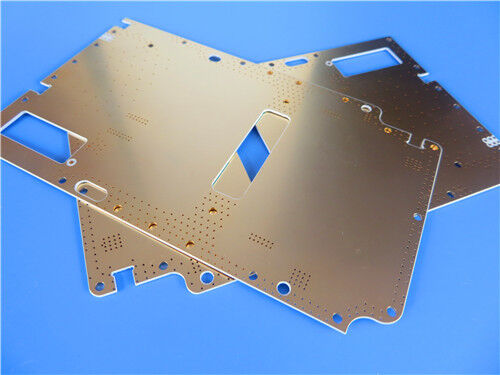
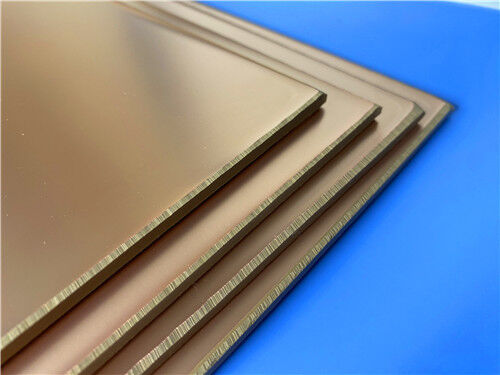
| Brand Name: | Rogers | Model Number: | RO3010 |
|---|
Product Description
When a design requires both a high dielectric constant for circuit miniaturization and the mechanical stability of a thick multilayer construction, the challenge extends beyond material selection—it becomes a question of how to combine materials with different thermal and mechanical characteristics into a reliable finished board. The RO3010 laminate from Rogers Corporation addresses the electrical side of this equation, while careful stack-up design and lamination process control address the mechanical side.
RO3010 is a ceramic-filled PTFE composite that offers a dielectric constant of 10.2 ± 0.30 at 10 GHz with a dissipation factor of 0.0022, enabling significant size reduction in RF and microwave circuits. The material exhibits exceptional dimensional stability, with a CTE of 13 ppm/°C in X, 11 ppm/°C in Y, and 16 ppm/°C in Z—closely matched to copper for reliable plated through-holes even in severe thermal environments. RO3010 is available in standard thicknesses from 0.005″ (0.13mm) to 0.050″ (1.28mm) and can be fabricated using standard PTFE circuit board processing techniques.
| RO3010 Typical Value | |||||
| Property | RO3010 | Direction | Units | Condition | Test Method |
| Dielectric Constant,εProcess | 10.2±0.05 | Z | 10 GHz/23℃ | IPC-TM-650 2.5.5.5 Clamped Stripline | |
| Dielectric Constant,εDesign | 11.2 | Z | 8GHz to 40 GHz | Differential Phase Length Method | |
| Dissipation Factor,tanδ | 0.0022 | Z | 10 GHz/23℃ | IPC-TM-650 2.5.5.5 | |
| Thermal Coefficient of ε | -395 | Z | ppm/℃ | 10 GHz -50℃to 150℃ | IPC-TM-650 2.5.5.5 |
| Dimensional Stability | 0.35 0.31 |
X Y |
mm/m | COND A | IPC-TM-650 2.2.4 |
| Volume Resistivity | 105 | MΩ.cm | COND A | IPC 2.5.17.1 | |
| Surface Resistivity | 105 | MΩ | COND A | IPC 2.5.17.1 | |
| Tensile Modulus | 1902 1934 |
X Y |
MPa | 23℃ | ASTM D 638 |
| Moisture Absorption | 0.05 | % | D48/50 | IPC-TM-650 2.6.2.1 | |
| Specific Heat | 0.8 | j/g/k | Calculated | ||
| Thermal Conductivity | 0.95 | W/M/K | 50℃ | ASTM D 5470 | |
| Coefficient of Thermal Expansion (-55 to 288℃) |
13 11 16 |
X Y Z |
ppm/℃ | 23℃/50% RH | IPC-TM-650 2.4.4.1 |
| Td | 500 | ℃ TGA | ASTM D 3850 | ||
| Density | 2.8 | gm/cm3 | 23℃ | ASTM D 792 | |
| Copper Peel Stength | 9.4 | Ib/in. | 1oz,EDC After Solder Float | IPC-TM 2.4.8 | |
| Flammability | V-0 | UL 94 | |||
| Lead-free Process Compatible | Yes | ||||
| PCB Capability (RO3010) | |
| PCB Material: | Ceramic-filled PTFE composites |
| Designation: | RO3010 |
| Dielectric constant: | 10.2±0.3 |
| Layer count: | Single Layer, Double Layer, Multilayer, Hybrid PCB |
| Copper weight: | 1oz (35µm), 2oz (70µm) |
| PCB thickness: | 5mil (0.127mm), 10mil (0.254mm), 25mil(0.635mm), 50mil (1.27mm) |
| PCB size: | ≤400mm X 500mm |
| Solder mask: | Green, Black, Blue, Yellow, Red etc. |
| Surface finish: | Bare copper, HASL, Immersion tin, Immersion silver, Immersion gold, Pure gold, ENEPIG, OSP etc.. |
Applications
Custom PCB Manufacturing on RO3010
As a specialized manufacturer of high-frequency printed circuit boards, we offer comprehensive fabrication services using Rogers RO3010 and other advanced materials. The following specification details a representative 4-layer mixed-material implementation:
PCB Construction Details:
| Parameter | Specification |
| Configuration | 4-layer board |
| Stack-up | 1.27mm RO3010 + 1080 (0.076mm) FR-4 PP + 1.27mm RO3010 |
| Finished Thickness | 2.8mm |
| Copper Weight | 1 oz per layer |
| Surface Finish | Immersion Tin |
| Silkscreen | White legend (oil-free) |
| Board Dimensions | 143mm × 97.5mm (1 piece) |
| Quality Standard | IPC-Class-2 |
Stack-up Configuration:
Design Essentials for Mixed-Material Stack-Up
Symmetric Stack-Up for Warpage Mitigation:
The 1.27mm + 0.076mm + 1.27mm stack-up is inherently symmetrical, which is critical when bonding materials with different CTE values. An asymmetric stack-up would create unbalanced thermal stress during lamination and subsequent thermal cycling, leading to warpage. The symmetric construction places identical RO3010 cores on either side of the FR-4 prepreg bond layer, balancing the mechanical forces through the thickness of the board.
CTE Matching Analysis:
RO3010 has a CTE of 13/11/16 ppm/°C (X/Y/Z), while typical FR-4 prepreg has a CTE in the range of 50-70 ppm/°C below Tg and significantly higher above Tg. The thin 0.076mm prepreg layer between two thick RO3010 cores minimizes the influence of this CTE mismatch. The total CTE of the composite structure is dominated by the two 1.27mm RO3010 layers, which are closely matched to copper. This design ensures that the overall board expansion remains compatible with copper plated through-holes, reducing stress on barrel plating during thermal cycling.
1080 Prepreg Selection and Resin Flow Control:
The 1080 glass style prepreg was selected for this application due to its high resin content (typically 45-55%) and excellent flow characteristics. With a nominal thickness of 0.076mm, the 1080 provides sufficient resin to fill the gaps between inner-layer copper features while maintaining the target bond-line thickness. The high resin flow capability of 1080 is essential for filling the 1.27mm RO3010 core surface topography, which may include copper features on the inner layers.
Lamination Risk Factors and Mitigation:
Resin Flow and Filling: The 1080 prepreg must flow sufficiently to fill copper gaps without excessive flow that would starve the bond line. Insufficient flow leads to voids and delamination; excessive flow causes resin-starved areas and potential electrical failures. Process parameters should target a controlled flow range, typically 15-25 psi lamination pressure with a controlled ramp rate to allow resin to fill gaps before gelation.
Interlayer Adhesion: Achieving reliable adhesion between the PTFE-based RO3010 surface and the epoxy-based FR-4 prepreg requires proper surface preparation. RO3010 surfaces should be chemically prepared (sodium or plasma treatment) prior to bonding to promote adhesion. The prepreg’s resin system must be compatible with the PTFE surface chemistry.
Dimensional Stability: The RO3010 cores and FR-4 prepreg have different thermal expansion behaviors. During the lamination cool-down cycle, residual stresses develop at the bond interface. Cooling under pressure is recommended to maintain dimensional control and prevent delamination. The symmetric stack-up further mitigates this by balancing stresses on both sides of the prepreg.
Thickness Control: Achieving the 2.8mm finished thickness requires precise control of the prepreg bond-line thickness after lamination. The 1080 prepreg, with 0.076mm nominal thickness, will compress during lamination. The final thickness depends on resin flow, copper thickness, and lamination pressure. Process validation with test panels is recommended to establish the correct press parameters for the target finished thickness.
Material Advantages
High Dielectric Constant for Compact Designs:
With a Dk of 10.2, RO3010 enables significant size reduction in RF and microwave circuits. This makes it an excellent choice for patch antennas, filters, and other components where footprint is at a premium.
Excellent Dimensional Stability:
The copper-matched X/Y CTE of 13/11 ppm/°C provides exceptional dimensional stability, allowing for tight registration tolerances and reliable plated through-holes even in thick multilayer constructions.
Low Thermal Coefficient of Dk:
Despite its high Dk, RO3010 maintains a thermal coefficient of Dk of -395 ppm/°C, ensuring predictable performance across temperature. This is important for applications where phase stability over temperature is critical.
High Thermal Conductivity:
At 0.95 W/m·K, RO3010 offers superior heat dissipation compared to standard PTFE laminates, supporting high-power RF applications.
Mixed-Material Compatibility:
RO3010 can be combined with FR-4 prepreg to create cost-effective hybrid stack-ups, leveraging the high-frequency performance of RO3010 for critical layers while using FR-4 for bonding and mechanical support.
Quality and Availability
All boards are manufactured in compliance with IPC-Class-2 quality standards, ensuring robust reliability for commercial, industrial, and automotive applications. 100% electrical testing is performed prior to shipment to guarantee functional integrity.
Our production capability extends to worldwide availability, with flexible shipping and logistics support for both prototype and volume requirements. We offer rapid turnaround and competitive pricing while maintaining strict process control.
For inquiries about custom stack-ups, mixed-material configurations combining RO3010 with FR-4 prepreg, controlled-depth features, alternative surface finishes, or other requirements, please contact our sales engineering team—we are ready to support your high-frequency circuit board requirements.
Enter Your Message

RO4350B, 4003C; Rogers 5880, 5870, 6002, 6010, 6006, 6035; RO3003, RO3035, RO3006, RO3010, RO3210,RO3203
TLX-8, TLX-6, TLX-9, TLX-0, TLX-7, TLY-3, TLY-5, RF-35TC, RF-60TC, RF-35A2, RF-60A, AD450, AD600, TMM4, TC350
| Shenzhen Bicheng Electronics Technology Co., Ltd |
| 6-11C Shidai Jingyuan Fuyong Town, Baoan District, Shenzhen City, Guangdong Province, China |
| 86-755-27374946 |
| sales30@bichengpcb.com |