


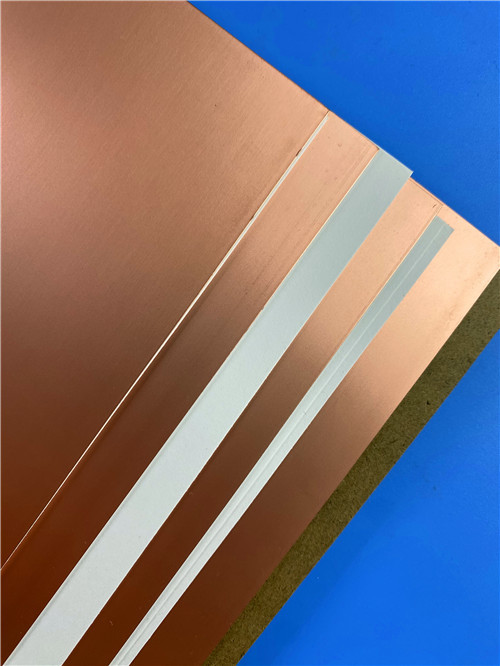

WL-CT350 High-Frequency Laminate: Is This FR-4 Processable, Low-Loss Material Right for Your Antenna PCB?
Contact Person : Sally Mao
Phone Number : 86-755-27374847
WhatsApp : +8618277967574
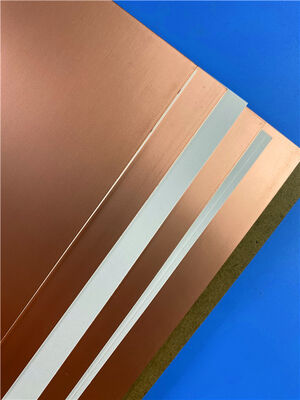
| Minimum Order Quantity : | 1PCS | Price : | 0.99-99USD/PCS |
|---|---|---|---|
| Packaging Details : | Packing | Delivery Time : | 2-10 working days |
| Payment Terms : | T/T, Paypal | Supply Ability : | 50000pcs |
| Place of Origin: | China | Brand Name: | Wangling |
|---|---|---|---|
| Certification: | ISO9001 | Model Number: | F4BTMS265 |
Product Description
Introduction
In the demanding world of aerospace, defense, and high-frequency communications, material performance and reliability are paramount. F4BTMS265 from Taizhou Wangling Insulation Material Factory represents a significant advancement in PTFE-based composite technology. As part of the F4BTMS series—the upgraded successor to the F4BTM family—this material combines the benefits of ultra-thin, ultra-fine glass fiber reinforcement with high ceramic filling to deliver exceptional electrical, thermal, and mechanical performance.
F4BTMS265 offers a dielectric constant of 2.65 with ultra-low dissipation factor, making it ideal for phase-sensitive applications, microwave circuits, and aerospace systems where signal integrity and dimensional stability are critical. Its unique construction minimizes the "fiberglass effect" on electromagnetic wave propagation while maintaining excellent dimensional stability—a balance that traditional woven fiberglass PTFE materials struggle to achieve.
This article provides a comprehensive overview of F4BTMS265 laminate properties, a detailed 2-layer PCB design example, and key sourcing information for engineers and procurement professionals.
What Is F4BTMS265 Laminate?
F4BTMS265 is a high-performance PTFE (polytetrafluoroethylene) composite substrate from the F4BTMS series manufactured by Taizhou Wangling Insulation Material Factory. The material represents a technological breakthrough over the previous F4BTM series, featuring an advanced formulation that combines:
Ultra-thin, ultra-fine glass fiber cloth – Minimal reinforcement that reduces the "fiberglass effect"
High ceramic filling – Large amounts of uniformly distributed specialty nano-ceramics mixed with PTFE resin
Optimized processing – Proprietary manufacturing techniques for superior consistency
Key Differentiator: Minimized Fiberglass Effect with Enhanced Stability
Unlike traditional woven fiberglass PTFE materials, F4BTMS265 uses ultra-thin, ultra-fine glass fiber cloth as reinforcement. This unique approach:
Minimizes the "fiberglass effect" – Reduces dielectric anisotropy and non-uniformity during electromagnetic wave propagation
Lowers dielectric loss – Achieves ultra-low dissipation factor compared to conventional woven glass PTFE
Enhances dimensional stability – Maintains excellent mechanical stability despite minimal glass content
Reduces X/Y/Z anisotropy – More isotropic electrical properties than traditional woven glass materials
Increases usable frequency – Stable performance to 40 GHz and beyond
Aerospace-Grade Reliability
F4BTMS265 is designed for the most demanding aerospace and defense applications, featuring:
Excellent radiation resistance – Stable electrical and physical properties after irradiation exposure
Low outgassing – Meets vacuum outgassing requirements for space applications
Wide operating temperature range – -55°C to +260°C
Low moisture absorption – 0.025% for stable performance in humid environments
Properties of F4BTMS265 Laminate
| Property | Test Condition | Units | Typical Value |
| Electrical Properties | |||
| Dielectric Constant (Typical) | 10 GHz | – | 2.65 |
| Dielectric Constant (Design) | 10 GHz | – | 2.65 |
| Dielectric Constant Tolerance | – | – | ±0.04 |
| Dissipation Factor | 10 GHz | – | 0.0012 |
| 20 GHz | – | 0.0014 | |
| 40 GHz | – | 0.0018 | |
| Temperature Coefficient of Dk (TCDk) | -55°C to 150°C | ppm/°C | -88 |
| Peel Strength (1 oz RTF Copper) | – | N/mm | >1.8 |
| Volume Resistivity | Normal | MΩ·cm | ≥1 × 10⁸ |
| Surface Resistivity | Normal | MΩ | ≥1 × 10⁸ |
| Electrical Strength (Z-direction) | – | kV/mm | >34 |
| Breakdown Voltage (XY-direction) | – | kV | >42 |
| Thermal Properties | |||
| CTE (X-axis) | -55°C to 288°C | ppm/°C | 15 |
| CTE (Y-axis) | -55°C to 288°C | ppm/°C | 20 |
| CTE (Z-axis) | -55°C to 288°C | ppm/°C | 72 |
| Thermal Stress | 260°C, 10s, 3 cycles | – | No delamination |
| Thermal Conductivity | Z-direction | W/(m·K) | 0.36 |
| Long-Term Operating Temperature | – | °C | -55 to +260 |
| Mechanical & Physical Properties | |||
| Moisture Absorption | 20±2°C, 24 hours | % | 0.025 |
| Density | Room temperature | g/cm³ | 2.26 |
| Flammability | – | UL-94 | V-0 |
| Material Composition | – | – | PTFE + Ultra-thin glass fiber + Ceramic |
Ultra-Low Loss Across Frequency
F4BTMS265 demonstrates exceptional low-loss performance across a wide frequency range:
| Frequency | Dissipation Factor |
| 10 GHz | 0.0012 |
| 20 GHz | 0.0014 |
| 40 GHz | 0.0018 |
This ultra-low loss characteristic makes F4BTMS265 ideal for phase-sensitive applications where signal integrity must be maintained over long transmission paths.
Excellent Frequency Stability (Up to 40 GHz)
F4BTMS265 maintains stable dielectric constant and low loss values up to 40 GHz, making it suitable for:
Phase-sensitive antennas – Stable phase performance across frequency
Microwave circuits – Consistent impedance and signal integrity
Radar systems – Reliable performance in demanding military applications
Temperature Stability
With a TCDk of -88 ppm/°C from -55°C to 150°C, F4BTMS265 offers:
Stable phase performance – Minimal dielectric constant variation across temperature
Reliable operation – Consistent electrical performance in extreme environments
Wide operating range – -55°C to +260°C long-term use
Low CTE for Dimensional Stability
F4BTMS265's CTE values (15/20/72 ppm/°C in X/Y/Z) provide:
Excellent dimensional stability – Critical for multi-layer and high-density designs
Reliable PTHs – Reduced thermal stress on plated-through-holes
Consistent registration – Maintains alignment across temperature cycles
Features and Benefits Summary
| Feature | Benefit |
| Ultra-thin, ultra-fine glass fiber reinforcement | Minimized "fiberglass effect"; reduced anisotropy; lower dielectric loss |
| High ceramic filling | Enhanced dimensional stability; improved thermal and mechanical properties |
| Dk of 2.65 ± 0.04 | Tight tolerance; excellent lot-to-lot consistency |
| Ultra-low Df (0.0012 @ 10 GHz) | Excellent signal integrity; low transmission loss |
| Stable performance to 40 GHz | Suitable for microwave, radar, and phase-sensitive applications |
| TCDk of -88 ppm/°C | Temperature-stable dielectric constant; reliable phase performance |
| CTE of 15/20/72 ppm/°C | Excellent dimensional stability; reliable PTHs |
| Radiation resistance | Stable performance after irradiation exposure; space-qualified |
| Low outgassing | Meets vacuum outgassing requirements for space applications |
| Low moisture absorption (0.025%) | Stable performance in humid environments |
| Long-term operating temperature (-55°C to +260°C) | Suitable for extreme environments |
| UL 94 V-0 flammability | Safety certified for critical applications |
| RTF low-roughness copper foil (standard) | Reduced conductor loss; excellent peel strength (>1.8 N/mm) |
| Standard PTFE processing | Compatible with standard PTFE PCB fabrication techniques |
Standard Offerings
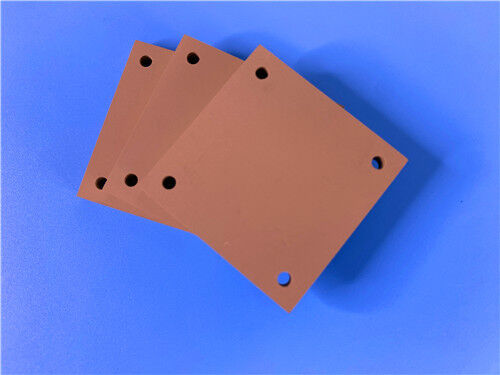
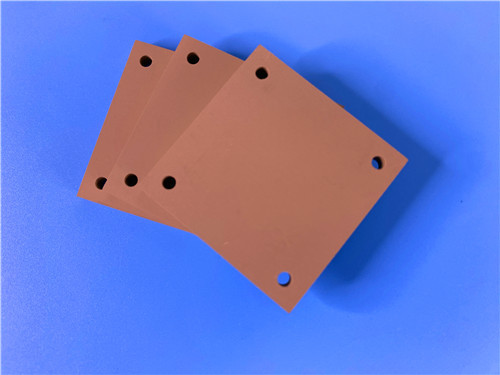
F4BTMS265 and the F4BTMS series are available in a wide range of thicknesses, panel sizes, and copper cladding options.
| Thickness (mm) | Thickness (mil) | Tolerance (mm) | Tolerance (mil) |
| 0.127 | 5 | ±0.0127 | ±0.5 |
| 0.254 | 10 | ±0.02 | ±1.0 |
| 0.508 | 20 | ±0.03 | ±1.19 |
| 0.635 | 25 | ±0.04 | ±1.58 |
| 0.762 | 30 | ±0.04 | ±1.58 |
| 0.787 | 30.1 | ±0.04 | ±1.58 |
| 1.016 | 40 | ±0.05 | ±2.0 |
| 1.27 | 50 | ±0.05 | ±2.0 |
| 1.5 | 59 | ±0.06 | ±2.5 |
| 1.524 | 60 | ±0.06 | ±2.5 |
| 1.575 | 62 | ±0.06 | ±2.5 |
| 2.03 | 80 | ±0.08 | ±3.2 |
| 2.54 | 100 | ±0.10 | ±4.0 |
| 3.175 | 125 | ±0.13 | ±5.0 |
| 4.06 | 160 | ±0.18 | ±7.0 |
| 5.08 | 200 | ±0.20 | ±8.0 |
| 6.35 | 250 | ±0.25 | ±10.0 |
Note: Minimum thickness is 0.127mm. Additional thicknesses available in 0.127mm increments. Custom thicknesses available upon request.
Standard Panel Sizes & Copper Claddings
| Parameter | Options |
| Standard Panel Sizes | 305 × 460 mm (12" × 18") |
| 460 × 610 mm (18" × 24") | |
| 610 × 920 mm (24" × 36") | |
| Custom sizes available | |
| Copper Thickness | 0.5 oz (18 μm) |
| 1.0 oz (35 μm) | |
| Other thicknesses available upon request | |
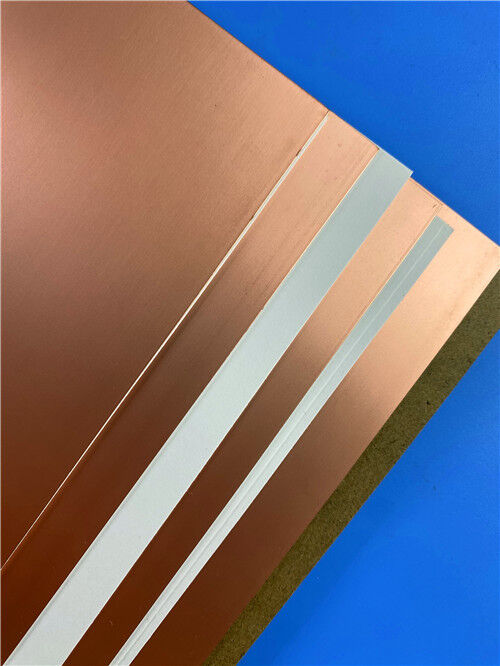
| Copper Foil Types | RTF – Low-roughness copper (standard) |
| 50Ω Embedded Resistor Copper Foil (NiP alloy, 0.2μm thickness, 50±5Ω/sq) | |
| Copper-clad or aluminum-clad versions available |
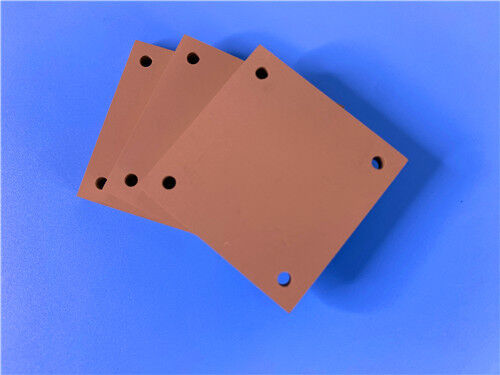
Metal-Backed Options (F4BTMS265-AL / F4BTMS265-CU)
F4BTMS series also offers metal-backed versions for shielding or heat dissipation applications:
| Model | Metal Base | Density (g/cm³) | Thermal Conductivity (W/m·K) | CTE (ppm/°C) | Available Metal Thickness (mm) | Panel Size (mm) |
| F4BTMS265-CU | Copper | 8.9 | 380 | 17 | 0.48, 0.98, 1.48, 1.98, 2.98, 3.98 | 460 × 610 |
| F4BTMS265-AL | Aluminum | 2.7 | 180 | 24 | 460 × 305 |
Note: Metal thickness tolerance: +0.02 / -0.05 mm. Custom thicknesses available upon request.
F4BTMS265-AL = F4BTMS265 with aluminum backing
F4BTMS265-CU = F4BTMS265 with copper backing
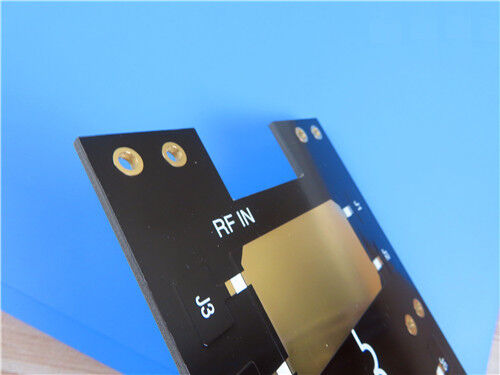
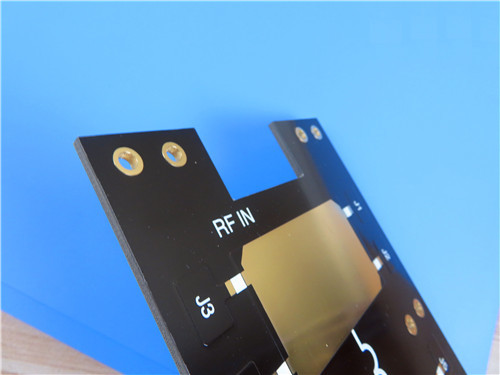
2-Layer PCB Design Example Using F4BTMS265
To demonstrate the practical application of F4BTMS265, the following is a complete 2-layer rigid PCB design case.
PCB Design Specifications
| Parameter | Specification |
| Base Material | F4BTMS265 (Taizhou Wangling) |
| Layer Count | 2-layer rigid |
| Board Dimensions | 97.00 mm × 76.00 mm per panel, ±0.15 mm |
| Minimum Trace/Space | 14 / 14 mils |
| Minimum Hole Size | 0.25 mm |
| Blind/Buried Vias | None |
| Finished Cu Weight | 1 oz (35 μm) all layers |
| Via Plating Thickness | 20 μm |
| Surface Finish | ENIG (Electroless Nickel Immersion Gold) |
| Top Silkscreen | White |
| Bottom Silkscreen | None |
| Top Solder Mask | Black |
| Bottom Solder Mask | None |
| Electrical Testing | 100% prior to shipment |
| Artwork Format | Gerber RS-274-X |
| Accepted Standard | IPC-Class-2 |
| Service Area | Worldwide |
Design Observations
This board (97 mm × 76 mm) features a significant component count (39 components) with only 2 nets, suggesting a complex RF or microwave functional module. Key observations include:
30 mil (0.762 mm) dielectric thickness – Standard thickness for high-frequency PCB designs
Black solder mask on top layer – Provides protection and aesthetic consistency; black solder mask is often preferred for high-frequency applications due to its matte finish and reduced reflectivity
White silkscreen on top layer – Clear component marking against black solder mask; improves assembly and inspection
ENIG surface finish – Provides excellent solderability and flatness for RF connections
Generous trace/spacing (14/14 mils) – Suggests the design may involve higher voltage or power considerations, or may simply be a less densely populated RF design
High via count (25 vias) – Reflects the need for frequent grounding or shielding in a microwave design
F4BTMS265's low loss (Df ≈ 0.0012 @ 10 GHz) – Critical for maintaining signal integrity at high frequencies
IPC-Class-2 compliance – Ensures reliability for commercial aerospace and defense applications
Manufacturing Process Highlights
Standard PTFE processing – F4BTMS265 can be fabricated using standard PTFE PCB techniques
Excellent dimensional stability – Ultra-thin glass fiber reinforcement minimizes distortion during processing
Dense-hole capability – Supports 0.25 mm minimum hole size
Multi-layer capability – Suitable for multi-layer and backplane applications
100% electrical testing – Guarantees functional integrity of every board
Typical Applications
- Aerospace equipment, space and cabin equipment
- Microwave, RF
- Radar, military radar
- Feed networks
- Phase-sensitive antennas, phased array antennas
- Satellite communications, and more
Conclusion
F4BTMS265 from Taizhou Wangling Insulation Material Factory represents a significant advancement in PTFE-based composite technology, combining the benefits of ultra-thin, ultra-fine glass fiber reinforcement, high ceramic filling, and aerospace-grade reliability. With a dielectric constant of 2.65 ± 0.04, dissipation factor of 0.0012 at 10 GHz, and stable performance up to 40 GHz, F4BTMS265 delivers the performance required for the most demanding microwave, radar, and aerospace applications.
Key advantages include:
Aerospace-grade reliability – Radiation resistant, low outgassing, space-qualified
Ultra-low loss (Df = 0.0012 @ 10 GHz) – Excellent signal integrity for phase-sensitive applications
Ultra-thin glass reinforcement – Minimized "fiberglass effect"; reduced anisotropy
40 GHz capability – Suitable for microwave and radar applications
Excellent temperature stability – TCDk of -88 ppm/°C from -55°C to 150°C
Low CTE (15/20/72 ppm/°C) – Excellent dimensional stability; reliable PTHs
Low moisture absorption (0.025%) – Stable performance in all environments
Cost-effective alternative – Replaces similar Western materials with competitive pricing
Standard PTFE processing – Compatible with standard fabrication techniques
Whether used in spacecraft electronics, military radar, or phase-sensitive antenna systems, F4BTMS265 provides a reliable, high-performance foundation for demanding high-frequency circuit designs.
Enter Your Message

RO4350B, 4003C; Rogers 5880, 5870, 6002, 6010, 6006, 6035; RO3003, RO3035, RO3006, RO3010, RO3210,RO3203
TLX-8, TLX-6, TLX-9, TLX-0, TLX-7, TLY-3, TLY-5, RF-35TC, RF-60TC, RF-35A2, RF-60A, AD450, AD600, TMM4, TC350
| Shenzhen Bicheng Electronics Technology Co., Ltd |
| 6-11C Shidai Jingyuan Fuyong Town, Baoan District, Shenzhen City, Guangdong Province, China |
| 86-755-27374946 |
| sales30@bichengpcb.com |