


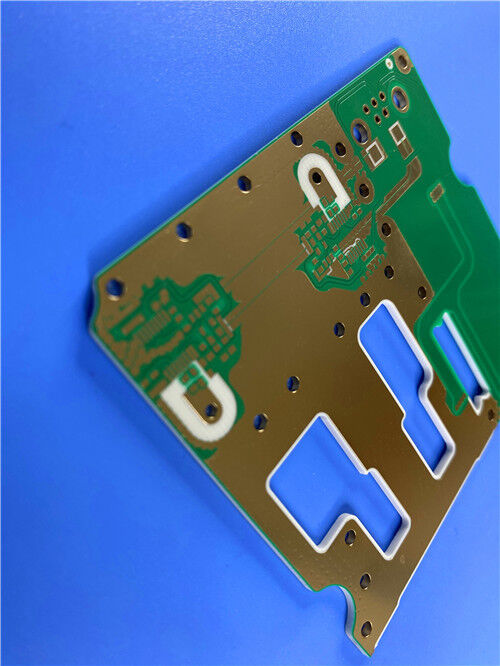

I-Tera® MT40 Very Low-Loss Laminate – Double-Layer PCB with Castellated Edges
Contact Person : Sally Mao
Phone Number : 86-755-27374847
WhatsApp : +8618277967574
| Brand Name: | Rogers | Model Number: | RO4003C |
|---|
Product Description
1. Material Overview – RO4003C (Rogers)
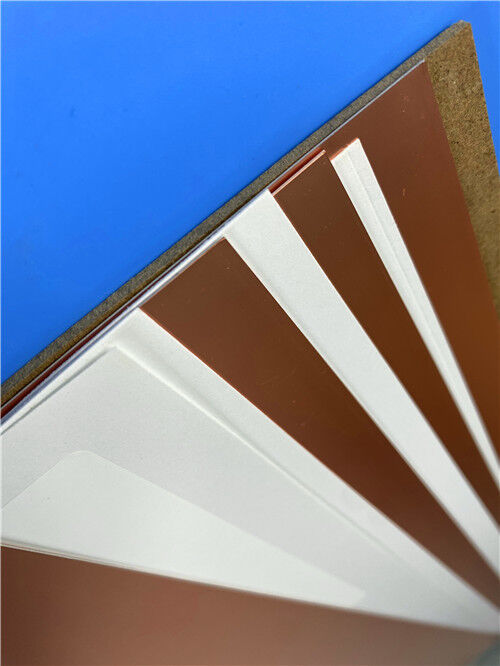
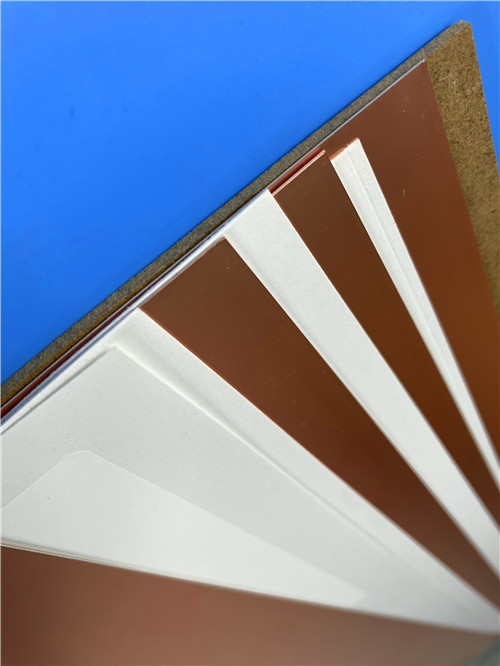
RO4003C is a hydrocarbon ceramic laminate from Rogers Corporation, specifically designed for high-frequency RF/microwave applications. It offers superior high-frequency performance and low-cost circuit fabrication using standard epoxy/glass (FR-4) processes .
Key Material Characteristics
| Feature | Benefit |
| Dk = 3.38 ± 0.05 @ 10 GHz | Low and stable dielectric constant – consistent impedance across frequency |
| Df = 0.0027 @ 10 GHz | Very low dissipation factor – minimizes insertion loss |
| Tg > 280°C (TMA) | High thermal stability – supports lead-free assembly |
| Td = 425°C | Excellent thermal decomposition resistance – robust for harsh environments |
| TCDk = +40 ppm/°C | Stable Dk across temperature (-50°C to 150°C) |
| CTE X/Y = 11–14 ppm/°C | Matches copper's CTE – reduces PTH stress |
| Moisture Absorption = 0.06% | Maintains electrical stability in humid environments |
| FR-4 process compatible | No sodium etch or plasma desmear required – standard fabrication . |
| UL 94 V-0 | Meets safety requirements . |
RO4450F Bondply
RO4450F is a low-flow, thermoset prepreg specifically developed for bonding RO4000 series laminates in multilayer constructions . Key attributes:
| Property | Value |
| Resin System | Hydrocarbon ceramic |
| Flow Characteristics | Low-flow – minimizes resin bleed during lamination |
| Dielectric Constant | ~3.52 |
| Processing | Compatible with standard FR-4 lamination cycles |
| Cured Thickness | Dependent on glass style and pressure |
Multi-Layer Bonding
RO4450F bondply is used for bonding RO4003C cores. Guidelines for the adhesive system should be consulted for bond cycle parameters .
Typical Lamination Conditions:
| Parameter | Recommendation |
| Press Type | Hydraulic or vacuum press |
| Temperature | 190–210°C |
| Pressure | 300–400 psi |
| Dwell Time | 60–90 minutes |
| Cooling | Controlled cooling to <100°C before removal |
Drilling
Standard entry (aluminum or thin pressed phenolic) and exit (pressed phenolic or fiberboard) materials can be used. Drilling speeds greater than 500 SFM should be avoided .
Recommended Drilling Parameters:
| Parameter | Recommended Range |
| Surface Speed | 300–500 SFM (90–150 m/min) |
| Chip Load | 0.002–0.004"/rev. (0.05–0.10 mm) |
| Retract Rate | 500 IPM for tools < 0.0135"; 1,000 IPM for all others |
| Tool Type | Standard carbide |
| Tool Life | 2,000–3,000 hits |
Custom PCB – 4-Layer RO4003C + RO4450F Hybrid with Via-in-Pad & IPC Class 3
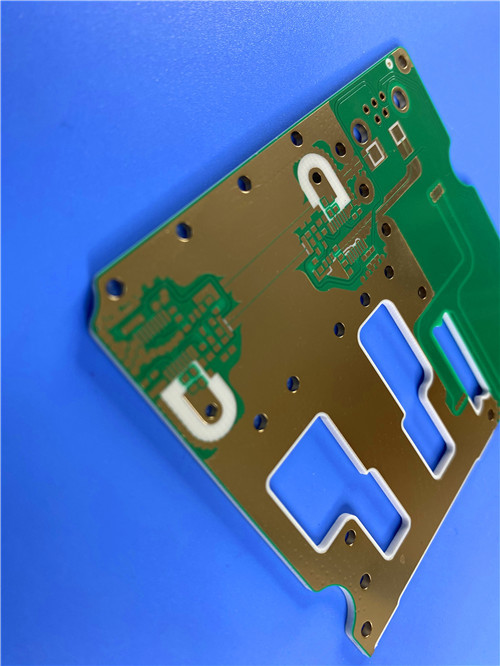
This 4-layer board demonstrates our capability to process RO4000 series materials with RO4450F bondply , advanced via-in-pad , and IPC-6012 Class 3 compliance .
Basic Specifications
| Item | Specification |
| Layer Count | 4 layers |
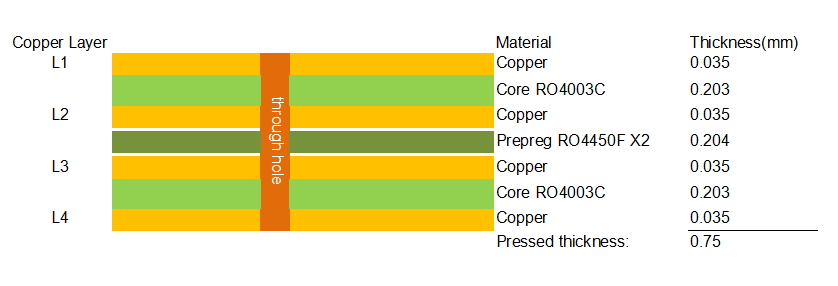
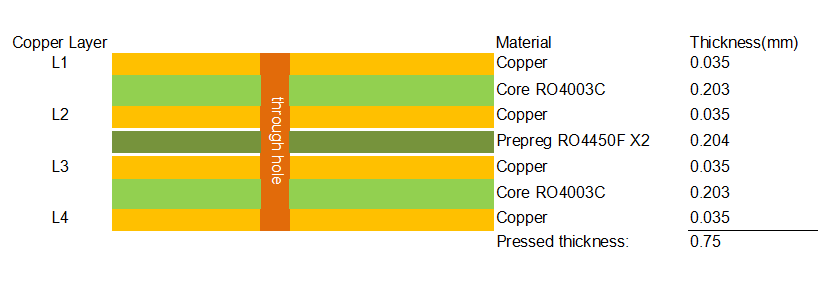
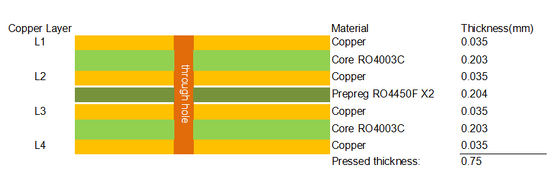
| Stack-Up | 0.203mm RO4003C + RO4450F (2× prepreg) + 0.203mm RO4003C |
| Finished Pressed Thickness | 0.75mm |
| Copper Weight | 1 oz / 1 oz / 1 oz / 1 oz (all layers) |
| Surface Finish | ENIG (2µ" gold over nickel) |
| Solder Mask (Top) | Green with black nomenclature |
| Solder Mask (Bottom) | Green with no nomenclature |
| Panel Size | 98mm × 62mm (1 piece) |
Stack-Up Cross-Section
Application Areas
Q1: What makes RO4003C different from standard FR-4?
A: RO4003C offers significantly lower Dk (3.38 vs. ~4.5) and Df (0.0027 vs. ~0.015–0.020) , higher Tg (>280°C) , stable Dk across temperature (TCDk = +40 ppm/°C) , and CTE matched to copper (11–14 ppm/°C) – all while remaining FR-4 process compatible .
Q2: Does RO4003C require special processing like PTFE materials?
A: No. Unlike PTFE, RO4003C does not require sodium etch or plasma desmear for through-hole preparation. It processes using standard FR-4 fabrication techniques .
Q3: What is RO4450F bondply, and why is it used?
A: RO4450F is a low-flow, thermoset prepreg specifically developed for bonding RO4000 series laminates in multilayer constructions. It minimizes resin bleed during lamination and provides excellent adhesion between cores .
Q4: What is the recommended lamination temperature for RO4450F?
A: Typical lamination temperature is 190–210°C with 300–400 psi pressure and 60–90 minutes dwell time. Controlled cooling to <100°C before removal is recommended.
Q5: Can all vias be resin-plugged and capped (via-in-pad)?
A: Yes. Our manufacturing process supports resin plugging + electroplated capping for all vias. This is standard for this 4-layer design and enables component placement directly over vias.
Q6: What surface finishes are available for RO4003C?
A: RO4003C is compatible with OSP, HASL, ENIG, immersion silver, immersion tin, and most chemically deposited or electroplated finishes .
Q7: What is the shelf life of RO4003C laminates?
A: RO4003C laminates can be stored for extended durations at ambient room temperatures (55–85°F, 13–30°C) . Copper claddings may oxidize during exposure to high humidity (removed by standard micro-etch) . Over >5 years, the exposed dielectric along panel edges may experience detectable oxidation, which is accounted for by standard tooling hole loss .
Contact Us
As a specialized PCB supplier based in China, we have extensive experience with Rogers RO4000 series materials , RO4450F bondply , and complex via-in-pad processes .
We provide:
For technical inquiries, stack-up review, or quotation requests, please contact our sales team directly. We are ready to support your RF/microwave and high-frequency projects.
Enter Your Message

RO4350B, 4003C; Rogers 5880, 5870, 6002, 6010, 6006, 6035; RO3003, RO3035, RO3006, RO3010, RO3210,RO3203
TLX-8, TLX-6, TLX-9, TLX-0, TLX-7, TLY-3, TLY-5, RF-35TC, RF-60TC, RF-35A2, RF-60A, AD450, AD600, TMM4, TC350
| Shenzhen Bicheng Electronics Technology Co., Ltd |
| 6-11C Shidai Jingyuan Fuyong Town, Baoan District, Shenzhen City, Guangdong Province, China |
| 86-755-27374946 |
| sales30@bichengpcb.com |