| MOQ: | 1PCS |
| Price: | 0.99-99USD/PCS |
| Standard Packaging: | Packing |
| Delivery Period: | 8 working days |
| Payment Method: | T/T, Paypal |
| Supply Capacity: | 50000pcs |
Introduction
In the most demanding high-frequency and millimeter-wave applications—where signal integrity, minimal insertion loss, and consistent electrical performance are paramount—material selection becomes the single most critical design decision. Rogers RT/duroid® 5880 represents the gold standard in ultra-low-loss PTFE-based laminates, delivering the lowest electrical loss among reinforced PTFE materials while maintaining exceptional dielectric constant uniformity.
Designed for exacting stripline and microstrip circuit applications, RT/duroid 5880's randomly oriented glass microfibers result in exceptional dielectric constant uniformity—both from panel to panel and across a wide frequency range. Its extremely low dissipation factor extends the material's usefulness to Ku-band, millimeter-wave frequencies, and beyond, making it a trusted choice for aerospace, defense, and advanced communications systems.
This article provides a comprehensive overview of RT/duroid 5880 laminate properties, a detailed 2-layer PCB design example, and key sourcing information for engineers and procurement professionals.
![]()
What Is Rogers RT/duroid 5880 Laminate?
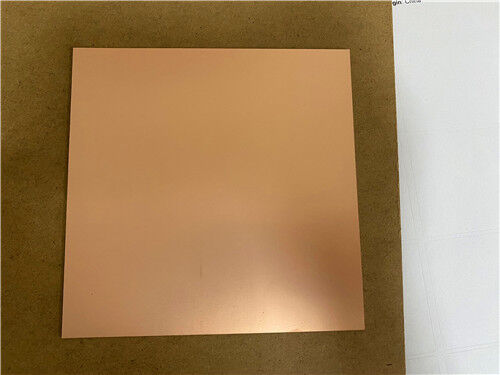
Rogers RT/duroid 5880 is a glass microfiber-reinforced PTFE (polytetrafluoroethylene) composite specifically engineered for high-frequency circuit applications. Unlike woven fiberglass-reinforced PTFE materials, RT/duroid 5880 utilizes randomly oriented microfibers, which eliminate the dielectric constant anisotropy and non-uniformity that can occur with woven reinforcements.
This unique construction results in:
Isotropic electrical properties – Consistent Dk regardless of orientation
Exceptional Dk uniformity – 2.20 ± 0.02 from panel to panel
Stable performance across frequency – Dk remains constant from low frequencies to millimeter-wave
Ultra-low dissipation factor – 0.0004 to 0.0009 @ 10 GHz, among the lowest for any reinforced PTFE material
Key Differentiator: The Lowest Loss in a Reinforced PTFE Material
RT/duroid 5880 offers the lowest dissipation factor of any reinforced PTFE laminate available today. With a Df as low as 0.0004 at 1 MHz and 0.0009 at 10 GHz, it outperforms woven fiberglass PTFE materials (like DiClad 527, Df ≈ 0.0017) and hydrocarbon ceramic materials (like RO4835, Df ≈ 0.0037). This ultra-low loss characteristic makes RT/duroid 5880 the material of choice for applications where every fraction of a dB of insertion loss matters—including satellite communications, millimeter-wave radar, and high-performance test equipment.
Properties of RT/duroid 5880 Laminate
| Property | Typical Value | Direction | Units | Condition | Test Method |
| Electrical Properties | |||||
| Dielectric Constant, εr (Process) | 2.20 ± 0.02 | Z | – | C24/23/50, 10 GHz | IPC-TM-650 2.5.5.5¹ |
| Dielectric Constant, εr (Process) | 2.2 | Z | – | C24/23/50, 1 MHz | IPC-TM-650 2.5.5.3 |
| Dielectric Constant, εr (Design) | 2.2 | Z | – | 8 GHz – 40 GHz | Differential Phase Length Method² |
| Dissipation Factor, tan δ | 0.0004 | Z | – | C24/23/50, 1 MHz | IPC-TM-650 2.5.5.3 |
| Dissipation Factor, tan δ | 0.0009 | Z | – | C24/23/50, 10 GHz | IPC-TM-650 2.5.5.5 |
| Thermal Coefficient of εr | -125 | Z | ppm/°C | -50°C to 150°C | IPC-TM-650 2.5.5.5 |
| Volume Resistivity | 2 × 10⁷ | Z | Mohm cm | C96/35/90 | ASTM D257 |
| Surface Resistivity | 3 × 10⁷ | Z | Mohm | C/96/35/90 | ASTM D257 |
| Thermal Properties | |||||
| Coefficient of Thermal Expansion (CTE) | 31 | X | ppm/°C | 0°C – 100°C | IPC-TM-650 2.4.41 |
| 48 | Y | ppm/°C | 0°C – 100°C | IPC-TM-650 2.4.41 | |
| 237 | Z | ppm/°C | 0°C – 100°C | IPC-TM-650 2.4.41 | |
| Thermal Conductivity | 0.2 | Z | W/m/K | 80°C | ASTM C518 |
| Specific Heat | 0.96 (0.23) | N/A | J/g/K (cal/g/°C) | – | Calculated |
| Decomposition Temperature (Td) | 500 | N/A | °C (TGA) | – | ASTM D3850 |
| Mechanical Properties | |||||
| Tensile Modulus (@ 23°C) | 1070 (156) | X | MPa (kpsi) | A | ASTM D638 |
| 860 (125) | Y | MPa (kpsi) | A | ASTM D638 | |
| Tensile Modulus (@ 100°C) | 450 (65) | X | MPa (kpsi) | A | ASTM D638 |
| 380 (55) | Y | MPa (kpsi) | A | ASTM D638 | |
| Ultimate Tensile Stress (@ 23°C) | 29 (4.2) | X | MPa (kpsi) | A | ASTM D638 |
| 27 (3.9) | Y | MPa (kpsi) | A | ASTM D638 | |
| Ultimate Tensile Stress (@ 100°C) | 20 (2.9) | X | MPa (kpsi) | A | ASTM D638 |
| 18 (2.6) | Y | MPa (kpsi) | A | ASTM D638 | |
| Ultimate Tensile Strain | 6 | X | % | A | ASTM D638 |
| 4.9 | Y | % | A | ASTM D638 | |
| Compressive Modulus (@ 23°C) | 710 (103) | X | MPa (kpsi) | A | ASTM D695 |
| 710 (103) | Y | MPa (kpsi) | A | ASTM D695 | |
| 940 (136) | Z | MPa (kpsi) | A | ASTM D695 | |
| Compressive Modulus (@ 100°C) | 500 (73) | X | MPa (kpsi) | A | ASTM D695 |
| 500 (73) | Y | MPa (kpsi) | A | ASTM D695 | |
| 670 (97) | Z | MPa (kpsi) | A | ASTM D695 | |
| Ultimate Compressive Stress | 27 (3.9) | X | MPa (kpsi) | A | ASTM D695 |
| 29 (5.3) | Y | MPa (kpsi) | A | ASTM D695 | |
| 52 (7.5) | Z | MPa (kpsi) | A | ASTM D695 | |
| Ultimate Compressive Strain | 8.5 | X | % | A | ASTM D695 |
| 7.7 | Y | % | A | ASTM D695 | |
| 12.5 | Z | % | A | ASTM D695 | |
| Physical & Environmental Properties | |||||
| Moisture Absorption | 0.02 | N/A | % | 0.062" (1.6mm), D48/50 | ASTM D570 |
| Density | 2.2 | N/A | gm/cm³ | N/A | ASTM D792 |
| Copper Peel Strength | 31.2 (5.5) | N/A | pli (N/mm) | 1 oz (35μm) EDC foil, after solder float | IPC-TM-650 2.4.8 |
| Flammability | V-0 | N/A | – | N/A | UL 94 |
| Lead-Free Process Compatible | Yes | N/A | – | N/A | – |
Notes:
1. Specification values are measured per IPC-TM-650 method 2.5.5.5 at ~10 GHz, 23°C. Testing based on 1 oz. electrodeposited copper foil.
2. The design Dk is an average number from several different tested lots of material on the most common thicknesses.
3. Typical values should not be used for specification limits, except where noted.
4. SI units given first with other frequently used units in parentheses.
A certificate of conformance containing lot-specific data accompanies each shipment.
Features and Benefits Summary
| Feature | Benefit |
| Ultra-low dissipation factor (0.0004 – 0.0009 @ 10 GHz) | Lowest loss among reinforced PTFE materials; extends usability to Ku-band and millimeter-wave |
| Dk of 2.20 ± 0.02 | Exceptional uniformity from panel to panel; predictable impedance control |
| Randomly oriented glass microfibers | Isotropic electrical properties; eliminates Dk anisotropy |
| Stable Dk across frequency | Consistent performance from low frequencies to >40 GHz |
| Low moisture absorption (0.02%) | Negligible performance drift in humid environments |
| Low Z-axis CTE (237 ppm/°C) | Reliable plated-through-holes in thermal environments |
| Excellent chemical resistance | Resistant to all solvents and reagents used in PCB processing |
| Lead-free process compatible | Suitable for modern high-temperature assembly processes |
| V-0 flammability rating | UL 94 compliant for safety-critical applications |
| Easy machinability | Can be cut, sheared, drilled, and milled to shape |
Standard Offerings
RT/duroid 5880 laminates are available in a comprehensive range of thicknesses, panel sizes, and copper cladding options.
| Thickness (Inches) | Thickness (mm) | Tolerance |
| 0.005" | 0.127 mm | ± 0.0005" |
| 0.010" | 0.252 mm | ± 0.0007" |
| 0.020" | 0.508 mm | ± 0.0015" |
| 0.031" | 0.787 mm | ± 0.0020" |
| 0.062" | 1.575 mm | ± 0.0030" |
Standard Panel Sizes & Claddings
| Parameter | Options |
| Standard Panel Sizes | 18" × 12" (457 × 305 mm) |
| 18" × 24" (457 × 610 mm) | |
| Additional panel sizes available | |
| Electrodeposited Copper (EDC) | ½ oz. (18 μm) HH/HH |
| 1 oz. (35 μm) *H1/H1* | |
| Rolled Copper Foil | ½ oz. (18 μm) *5R/5R* |
| 1 oz. (35 μm) *1R/1R* | |
| Additional Claddings | Heavy metal, resistive foil, unclad, aluminum, copper, or brass plate available |
2-Layer PCB Design Example Using RT/duroid 5880
To demonstrate the practical application of RT/duroid 5880, the following is a complete 2-layer rigid PCB design case.
![]()
PCB Design Specifications
| Parameter | Specification |
| Base Material | Rogers RT/duroid 5880 |
| Layer Count | 2-layer rigid |
| Board Dimensions | 102.00 mm × 65.00 mm per panel, ±0.15 mm |
| Minimum Trace/Space | 4 / 6 mils |
| Minimum Hole Size | 0.35 mm |
| Blind/Buried Vias | None |
| Finished Cu Weight | 1 oz (35 μm) all layers |
| Via Plating Thickness | 20 μm |
| Surface Finish | Immersion Gold (ENIG) |
| Top Silkscreen | None |
| Bottom Silkscreen | None |
| Top Solder Mask | None |
| Bottom Solder Mask | None |
| Electrical Testing | 100% prior to shipment |
| Artwork Format | Gerber RS-274-X |
| Accepted Standard | IPC-Class-2 |
| Service Area | Worldwide |
Design Observations
This larger board (102 mm × 65 mm) features a relatively high component count (46 components) and a significant number of vias (29 vias) despite having only 2 nets.
Key observations include:
High via density – Frequent grounding or shielding vias, typical of sensitive microwave designs operating at millimeter-wave frequencies
No solder mask – Preserves the ultra-low-loss characteristics of RT/duroid 5880; solder mask would introduce additional dielectric loss
No silkscreen – Maintains a clean RF surface; avoids contamination
ENIG surface finish – Provides excellent solderability and flatness; suitable for fine-pitch SMT components
RT/duroid 5880's ultra-low loss (Df ≈ 0.0009) – Critical for maintaining signal integrity at Ku-band and millimeter-wave frequencies
IPC-Class-2 compliance – Ensures reliability for commercial aerospace and defense applications
Manufacturing Process Highlights
Easily machined – RT/duroid 5880 laminates can be cut, sheared, drilled, and milled using standard PTFE processing techniques
Excellent chemical resistance – Resistant to all solvents and reagents used in etching circuits or plating edges and holes
Fine-pitch capability – 4/6 mil trace/spacing supports high-density millimeter-wave circuit layouts
100% electrical testing – Guarantees functional integrity of every board
Typical Applications
•Commercial Airline Broadband Antennas
• Microstrip and Stripline Circuits
• Millimeter Wave Applications
• Radar Systems
• Missile Guidance Systems
• Point to Point Digital Radio Antennas
Conclusion
Rogers RT/duroid 5880 laminates represent the pinnacle of ultra-low-loss PTFE-based materials for high-frequency and millimeter-wave applications. With a dielectric constant of 2.20 ± 0.02 and a dissipation factor as low as 0.0009 at 10 GHz, RT/duroid 5880 delivers the lowest electrical loss of any reinforced PTFE material available today.
Key advantages include:
Ultra-low loss (Df = 0.0004 – 0.0009) – Enables operation at Ku-band and millimeter-wave frequencies
Exceptional Dk uniformity (2.20 ± 0.02) – Predictable impedance control; consistent performance
Isotropic properties – Random microfiber reinforcement eliminates Dk anisotropy
Stable performance across frequency – Constant Dk from low frequencies to >40 GHz
Low moisture absorption (0.02%) – Negligible performance drift in humid environments
NASA low-outgassing – Suitable for aerospace and space applications
V-0 flammability – UL 94 compliant for safety-critical systems
Easy machinability – Can be cut, sheared, drilled, and milled using standard methods
Whether used in radar systems, satellite communications, millimeter-wave backhaul, or high-performance test equipment, RT/duroid 5880 provides the ultimate low-loss foundation for demanding high-frequency circuit designs.
| MOQ: | 1PCS |
| Price: | 0.99-99USD/PCS |
| Standard Packaging: | Packing |
| Delivery Period: | 8 working days |
| Payment Method: | T/T, Paypal |
| Supply Capacity: | 50000pcs |
Introduction
In the most demanding high-frequency and millimeter-wave applications—where signal integrity, minimal insertion loss, and consistent electrical performance are paramount—material selection becomes the single most critical design decision. Rogers RT/duroid® 5880 represents the gold standard in ultra-low-loss PTFE-based laminates, delivering the lowest electrical loss among reinforced PTFE materials while maintaining exceptional dielectric constant uniformity.
Designed for exacting stripline and microstrip circuit applications, RT/duroid 5880's randomly oriented glass microfibers result in exceptional dielectric constant uniformity—both from panel to panel and across a wide frequency range. Its extremely low dissipation factor extends the material's usefulness to Ku-band, millimeter-wave frequencies, and beyond, making it a trusted choice for aerospace, defense, and advanced communications systems.
This article provides a comprehensive overview of RT/duroid 5880 laminate properties, a detailed 2-layer PCB design example, and key sourcing information for engineers and procurement professionals.
![]()
What Is Rogers RT/duroid 5880 Laminate?
Rogers RT/duroid 5880 is a glass microfiber-reinforced PTFE (polytetrafluoroethylene) composite specifically engineered for high-frequency circuit applications. Unlike woven fiberglass-reinforced PTFE materials, RT/duroid 5880 utilizes randomly oriented microfibers, which eliminate the dielectric constant anisotropy and non-uniformity that can occur with woven reinforcements.
This unique construction results in:
Isotropic electrical properties – Consistent Dk regardless of orientation
Exceptional Dk uniformity – 2.20 ± 0.02 from panel to panel
Stable performance across frequency – Dk remains constant from low frequencies to millimeter-wave
Ultra-low dissipation factor – 0.0004 to 0.0009 @ 10 GHz, among the lowest for any reinforced PTFE material
Key Differentiator: The Lowest Loss in a Reinforced PTFE Material
RT/duroid 5880 offers the lowest dissipation factor of any reinforced PTFE laminate available today. With a Df as low as 0.0004 at 1 MHz and 0.0009 at 10 GHz, it outperforms woven fiberglass PTFE materials (like DiClad 527, Df ≈ 0.0017) and hydrocarbon ceramic materials (like RO4835, Df ≈ 0.0037). This ultra-low loss characteristic makes RT/duroid 5880 the material of choice for applications where every fraction of a dB of insertion loss matters—including satellite communications, millimeter-wave radar, and high-performance test equipment.
Properties of RT/duroid 5880 Laminate
| Property | Typical Value | Direction | Units | Condition | Test Method |
| Electrical Properties | |||||
| Dielectric Constant, εr (Process) | 2.20 ± 0.02 | Z | – | C24/23/50, 10 GHz | IPC-TM-650 2.5.5.5¹ |
| Dielectric Constant, εr (Process) | 2.2 | Z | – | C24/23/50, 1 MHz | IPC-TM-650 2.5.5.3 |
| Dielectric Constant, εr (Design) | 2.2 | Z | – | 8 GHz – 40 GHz | Differential Phase Length Method² |
| Dissipation Factor, tan δ | 0.0004 | Z | – | C24/23/50, 1 MHz | IPC-TM-650 2.5.5.3 |
| Dissipation Factor, tan δ | 0.0009 | Z | – | C24/23/50, 10 GHz | IPC-TM-650 2.5.5.5 |
| Thermal Coefficient of εr | -125 | Z | ppm/°C | -50°C to 150°C | IPC-TM-650 2.5.5.5 |
| Volume Resistivity | 2 × 10⁷ | Z | Mohm cm | C96/35/90 | ASTM D257 |
| Surface Resistivity | 3 × 10⁷ | Z | Mohm | C/96/35/90 | ASTM D257 |
| Thermal Properties | |||||
| Coefficient of Thermal Expansion (CTE) | 31 | X | ppm/°C | 0°C – 100°C | IPC-TM-650 2.4.41 |
| 48 | Y | ppm/°C | 0°C – 100°C | IPC-TM-650 2.4.41 | |
| 237 | Z | ppm/°C | 0°C – 100°C | IPC-TM-650 2.4.41 | |
| Thermal Conductivity | 0.2 | Z | W/m/K | 80°C | ASTM C518 |
| Specific Heat | 0.96 (0.23) | N/A | J/g/K (cal/g/°C) | – | Calculated |
| Decomposition Temperature (Td) | 500 | N/A | °C (TGA) | – | ASTM D3850 |
| Mechanical Properties | |||||
| Tensile Modulus (@ 23°C) | 1070 (156) | X | MPa (kpsi) | A | ASTM D638 |
| 860 (125) | Y | MPa (kpsi) | A | ASTM D638 | |
| Tensile Modulus (@ 100°C) | 450 (65) | X | MPa (kpsi) | A | ASTM D638 |
| 380 (55) | Y | MPa (kpsi) | A | ASTM D638 | |
| Ultimate Tensile Stress (@ 23°C) | 29 (4.2) | X | MPa (kpsi) | A | ASTM D638 |
| 27 (3.9) | Y | MPa (kpsi) | A | ASTM D638 | |
| Ultimate Tensile Stress (@ 100°C) | 20 (2.9) | X | MPa (kpsi) | A | ASTM D638 |
| 18 (2.6) | Y | MPa (kpsi) | A | ASTM D638 | |
| Ultimate Tensile Strain | 6 | X | % | A | ASTM D638 |
| 4.9 | Y | % | A | ASTM D638 | |
| Compressive Modulus (@ 23°C) | 710 (103) | X | MPa (kpsi) | A | ASTM D695 |
| 710 (103) | Y | MPa (kpsi) | A | ASTM D695 | |
| 940 (136) | Z | MPa (kpsi) | A | ASTM D695 | |
| Compressive Modulus (@ 100°C) | 500 (73) | X | MPa (kpsi) | A | ASTM D695 |
| 500 (73) | Y | MPa (kpsi) | A | ASTM D695 | |
| 670 (97) | Z | MPa (kpsi) | A | ASTM D695 | |
| Ultimate Compressive Stress | 27 (3.9) | X | MPa (kpsi) | A | ASTM D695 |
| 29 (5.3) | Y | MPa (kpsi) | A | ASTM D695 | |
| 52 (7.5) | Z | MPa (kpsi) | A | ASTM D695 | |
| Ultimate Compressive Strain | 8.5 | X | % | A | ASTM D695 |
| 7.7 | Y | % | A | ASTM D695 | |
| 12.5 | Z | % | A | ASTM D695 | |
| Physical & Environmental Properties | |||||
| Moisture Absorption | 0.02 | N/A | % | 0.062" (1.6mm), D48/50 | ASTM D570 |
| Density | 2.2 | N/A | gm/cm³ | N/A | ASTM D792 |
| Copper Peel Strength | 31.2 (5.5) | N/A | pli (N/mm) | 1 oz (35μm) EDC foil, after solder float | IPC-TM-650 2.4.8 |
| Flammability | V-0 | N/A | – | N/A | UL 94 |
| Lead-Free Process Compatible | Yes | N/A | – | N/A | – |
Notes:
1. Specification values are measured per IPC-TM-650 method 2.5.5.5 at ~10 GHz, 23°C. Testing based on 1 oz. electrodeposited copper foil.
2. The design Dk is an average number from several different tested lots of material on the most common thicknesses.
3. Typical values should not be used for specification limits, except where noted.
4. SI units given first with other frequently used units in parentheses.
A certificate of conformance containing lot-specific data accompanies each shipment.
Features and Benefits Summary
| Feature | Benefit |
| Ultra-low dissipation factor (0.0004 – 0.0009 @ 10 GHz) | Lowest loss among reinforced PTFE materials; extends usability to Ku-band and millimeter-wave |
| Dk of 2.20 ± 0.02 | Exceptional uniformity from panel to panel; predictable impedance control |
| Randomly oriented glass microfibers | Isotropic electrical properties; eliminates Dk anisotropy |
| Stable Dk across frequency | Consistent performance from low frequencies to >40 GHz |
| Low moisture absorption (0.02%) | Negligible performance drift in humid environments |
| Low Z-axis CTE (237 ppm/°C) | Reliable plated-through-holes in thermal environments |
| Excellent chemical resistance | Resistant to all solvents and reagents used in PCB processing |
| Lead-free process compatible | Suitable for modern high-temperature assembly processes |
| V-0 flammability rating | UL 94 compliant for safety-critical applications |
| Easy machinability | Can be cut, sheared, drilled, and milled to shape |
Standard Offerings
RT/duroid 5880 laminates are available in a comprehensive range of thicknesses, panel sizes, and copper cladding options.
| Thickness (Inches) | Thickness (mm) | Tolerance |
| 0.005" | 0.127 mm | ± 0.0005" |
| 0.010" | 0.252 mm | ± 0.0007" |
| 0.020" | 0.508 mm | ± 0.0015" |
| 0.031" | 0.787 mm | ± 0.0020" |
| 0.062" | 1.575 mm | ± 0.0030" |
Standard Panel Sizes & Claddings
| Parameter | Options |
| Standard Panel Sizes | 18" × 12" (457 × 305 mm) |
| 18" × 24" (457 × 610 mm) | |
| Additional panel sizes available | |
| Electrodeposited Copper (EDC) | ½ oz. (18 μm) HH/HH |
| 1 oz. (35 μm) *H1/H1* | |
| Rolled Copper Foil | ½ oz. (18 μm) *5R/5R* |
| 1 oz. (35 μm) *1R/1R* | |
| Additional Claddings | Heavy metal, resistive foil, unclad, aluminum, copper, or brass plate available |
2-Layer PCB Design Example Using RT/duroid 5880
To demonstrate the practical application of RT/duroid 5880, the following is a complete 2-layer rigid PCB design case.
![]()
PCB Design Specifications
| Parameter | Specification |
| Base Material | Rogers RT/duroid 5880 |
| Layer Count | 2-layer rigid |
| Board Dimensions | 102.00 mm × 65.00 mm per panel, ±0.15 mm |
| Minimum Trace/Space | 4 / 6 mils |
| Minimum Hole Size | 0.35 mm |
| Blind/Buried Vias | None |
| Finished Cu Weight | 1 oz (35 μm) all layers |
| Via Plating Thickness | 20 μm |
| Surface Finish | Immersion Gold (ENIG) |
| Top Silkscreen | None |
| Bottom Silkscreen | None |
| Top Solder Mask | None |
| Bottom Solder Mask | None |
| Electrical Testing | 100% prior to shipment |
| Artwork Format | Gerber RS-274-X |
| Accepted Standard | IPC-Class-2 |
| Service Area | Worldwide |
Design Observations
This larger board (102 mm × 65 mm) features a relatively high component count (46 components) and a significant number of vias (29 vias) despite having only 2 nets.
Key observations include:
High via density – Frequent grounding or shielding vias, typical of sensitive microwave designs operating at millimeter-wave frequencies
No solder mask – Preserves the ultra-low-loss characteristics of RT/duroid 5880; solder mask would introduce additional dielectric loss
No silkscreen – Maintains a clean RF surface; avoids contamination
ENIG surface finish – Provides excellent solderability and flatness; suitable for fine-pitch SMT components
RT/duroid 5880's ultra-low loss (Df ≈ 0.0009) – Critical for maintaining signal integrity at Ku-band and millimeter-wave frequencies
IPC-Class-2 compliance – Ensures reliability for commercial aerospace and defense applications
Manufacturing Process Highlights
Easily machined – RT/duroid 5880 laminates can be cut, sheared, drilled, and milled using standard PTFE processing techniques
Excellent chemical resistance – Resistant to all solvents and reagents used in etching circuits or plating edges and holes
Fine-pitch capability – 4/6 mil trace/spacing supports high-density millimeter-wave circuit layouts
100% electrical testing – Guarantees functional integrity of every board
Typical Applications
•Commercial Airline Broadband Antennas
• Microstrip and Stripline Circuits
• Millimeter Wave Applications
• Radar Systems
• Missile Guidance Systems
• Point to Point Digital Radio Antennas
Conclusion
Rogers RT/duroid 5880 laminates represent the pinnacle of ultra-low-loss PTFE-based materials for high-frequency and millimeter-wave applications. With a dielectric constant of 2.20 ± 0.02 and a dissipation factor as low as 0.0009 at 10 GHz, RT/duroid 5880 delivers the lowest electrical loss of any reinforced PTFE material available today.
Key advantages include:
Ultra-low loss (Df = 0.0004 – 0.0009) – Enables operation at Ku-band and millimeter-wave frequencies
Exceptional Dk uniformity (2.20 ± 0.02) – Predictable impedance control; consistent performance
Isotropic properties – Random microfiber reinforcement eliminates Dk anisotropy
Stable performance across frequency – Constant Dk from low frequencies to >40 GHz
Low moisture absorption (0.02%) – Negligible performance drift in humid environments
NASA low-outgassing – Suitable for aerospace and space applications
V-0 flammability – UL 94 compliant for safety-critical systems
Easy machinability – Can be cut, sheared, drilled, and milled using standard methods
Whether used in radar systems, satellite communications, millimeter-wave backhaul, or high-performance test equipment, RT/duroid 5880 provides the ultimate low-loss foundation for demanding high-frequency circuit designs.