logo
Products
PRODUCTS DETAILS
Home > Products >
What Is Rogers DiClad 527? – Complete Laminate Properties, PCB Stackup, and Fabrication Guide

What Is Rogers DiClad 527? – Complete Laminate Properties, PCB Stackup, and Fabrication Guide

MOQ: 1PCS
Price: 0.99-99USD/PCS
Standard Packaging: Packing
Delivery Period: 2-10 working days
Payment Method: T/T, Paypal
Supply Capacity: 50000pcs
Detail Information
Place of Origin
China
Brand Name
Rogers
Certification
ISO9001
Model Number
DiClad 527
Minimum Order Quantity:
1PCS
Price:
0.99-99USD/PCS
Packaging Details:
Packing
Delivery Time:
2-10 working days
Payment Terms:
T/T, Paypal
Supply Ability:
50000pcs
Product Description

The Ideal Foundation for High-Frequency Circuit Design: DiClad 527 Laminates and Their PCB Application


In today's rapidly evolving landscape of wireless communications, radar systems, and high-speed digital networks, the performance of high-frequency printed circuit boards (PCBs) directly determines the success or failure of the entire system. For circuits operating at high frequencies, signal integrity, low transmission loss, and stable electrical performance are the core objectives that designers pursue. To achieve these goals, beyond sophisticated circuit design, selecting the appropriate substrate material is the first and most critical step.

Rogers DiClad 527 high-performance laminates represent a proven material solution engineered precisely for these demanding high-frequency applications. This article explores the material characteristics of DiClad 527 and examines a specific 2-layer PCB design example to demonstrate its practical value in real-world applications.


What Is Rogers DiClad 527? – Complete Laminate Properties, PCB Stackup, and Fabrication Guide 0


DiClad 527: Material Properties and Technical Advantages

DiClad 527 belongs to Rogers' DiClad series and is a woven fiberglass-reinforced PTFE (polytetrafluoroethylene) composite material. Compared to non-woven fiberglass-reinforced PTFE laminates, its unique woven structure delivers significant performance advantages. The woven fiberglass reinforcement provides greater dimensional stability than non-woven alternatives with similar dielectric constants, while the consistent PTFE coating process ensures excellent dielectric constant uniformity across the material.


The electrical performance of DiClad 527 is validated through rigorous testing at both 1 MHz and 10 GHz. The table below summarizes all key electrical characteristics:


Electrical Properties of DiClad 527

Property Typical Value Units Test Conditions Test Method
Dielectric Constant (Dk) 2.40 – 2.60 23°C @ 50% RH, 10 GHz IPC TM-650 2.5.5.5
Dielectric Constant (Dk) 2.40 – 2.60 23°C @ 50% RH, 1 MHz IPC TM-650 2.5.5.3
Dissipation Factor (Df) 0.0017 23°C @ 50% RH, 10 GHz IPC TM-650 2.5.5.5
Dissipation Factor (Df) 0.001 23°C @ 50% RH, 1 MHz IPC TM-650 2.5.5.3
Thermal Coefficient of Dk -153 ppm/°C -10 to 140°C, 10 GHz IPC TM-650 2.5.5.5
Volume Resistivity 1.2 × 10⁹ MΩ-cm C96/35/90 IPC TM-650 2.5.17.1
Surface Resistivity 4.5 × 10⁷ C96/35/90 IPC TM-650 2.5.17.1
Dielectric Breakdown >45 kV D48/50 ASTM D-149
Arc Resistance >180 seconds ASTM D-495
Water Absorption 20±2°C, 24 hours ≤0.01%    
Long-Term Operating Temperature -100°C to +150°C    
Density 1.89 g/cm³    
Thermal Conductivity 0.44 W/(M·K)    
Material Composition PPO, Ceramic, ED copper foil    


Thermal and Mechanical Properties

Property Typical Value Units Test Conditions Test Method
CTE – X Axis 14 ppm/°C 50°C to 150°C IPC TM-650 2.4.41
CTE – Y Axis 21 ppm/°C 50°C to 150°C IPC TM-650 2.4.41
CTE – Z Axis 173 ppm/°C 50°C to 150°C IPC TM-650 2.4.24
Thermal Conductivity 0.26 W/(m·K) ASTM E1461
Copper Peel Strength 14 lbs/in 10s @ 288°C, 35 μm foil IPC TM-650 2.4.8
Young's Modulus 517 / 706 kpsi 23°C @ 50% RH ASTM D-638
Tensile Strength (MD, CMD) 19.0 / 15.0 kpsi 23°C @ 50% RH ASTM D-882
Compressive Modulus 359 kpsi 23°C @ 50% RH ASTM D-695
Flex Modulus 537 kpsi 23°C @ 50% RH ASTM D-3039


Physical and Environmental Properties of DiClad 527

Property Typical Value Units Test Conditions Test Method
Flammability V-0 C48/23/50 & C168/70 UL 94
Moisture Absorption 0.03 % E1/105+D24/23 IPC TM-650 2.6.2.2
Density 2.31 g/cm³ C24/23/50, Method A ASTM D792
NASA Outgassing – Total Mass Lost 0.02 % 125°C, ≤10⁻⁶ torr NASA SP-R-0022A
NASA Outgassing – Collected Volatiles 0 % 125°C, ≤10⁻⁶ torr NASA SP-R-0022A
NASA Outgassing – Water Vapor Recovered 0.01 % 125°C, ≤10⁻⁶ torr NASA SP-R-0022A


Performance Highlights: Stability Across Frequency

DiClad laminates demonstrate exceptional stability of both dielectric constant and dissipation factor across a wide frequency range. This inherent robustness simplifies the design process when working across the electromagnetic spectrum, ensuring:


Stable Dk across frequency – Enables easy design transition and scalability of designs


Stable Df across frequency – Provides a stable platform for high-frequency applications where signal integrity is critical to overall performance


These characteristics make DiClad 527 particularly valuable in filter, coupler, and low-noise amplifier applications, where dielectric constant uniformity is critical, as well as in power dividers and combiners, where low loss is essential.


Standard Offerings for DiClad 527 Laminate

DiClad 527 is available in a range of standard thicknesses, panel sizes, and copper cladding options to accommodate various design requirements.

Standard Thicknesses Standard Panel Sizes Standard Claddings
0.020" (0.508 mm) ± 0.0020" 12" × 18" (305 × 457 mm) Electrodeposited Copper Foil:
0.030" (0.762 mm) ± 0.0020" 18" × 12" (457 × 305 mm) • ½ oz. (18 μm)
0.060" (1.524 mm) ± 0.0020" 18" × 24" (457 × 610 mm) • 1 oz. (35 μm)
  24" × 18" (610 × 457 mm)  


2-Layer PCB Design Example Using DiClad 527
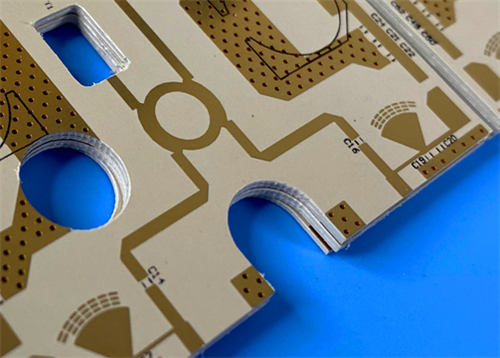
To illustrate the practical application of DiClad 527, consider the following 2-layer rigid PCB design case. This design leverages the material's key properties to achieve reliable high-frequency performance.


What Is Rogers DiClad 527? – Complete Laminate Properties, PCB Stackup, and Fabrication Guide 1


PCB Design Specifications

Parameter Specification
Base Material DiClad 527
Layer Count 2-layer rigid
Board Dimensions 49.63 mm × 91.54 mm per panel, ±0.15 mm
Minimum Trace/Space 4/6 mils
Minimum Hole Size 0.3 mm
Blind Vias None
Finished Cu Weight 1 oz (35 μm) outer layers
Via Plating Thickness 20 μm
Surface Finish Immersion Gold (ENIG)
Top Silkscreen Black
Bottom Silkscreen None
Top Solder Mask None
Bottom Solder Mask None
Electrical Testing 100% prior to shipment
Artwork Format Gerber RS-274-X
Accepted Standard IPC-Class-2
Availability Worldwide


The relatively simple structure with 2 nets suggests this design is likely used for dedicated functional modules such as antenna feed networks, filters, or other RF building blocks. The absence of solder mask layers on both top and bottom sides is a deliberate choice for applications requiring extremely low loss or specific dielectric environments where solder mask material could introduce unwanted parasitic effects.


Manufacturing Process Highlights

Fine Trace/Spacing (4/6 mils): Allows higher-density circuit layouts while maintaining controlled impedance.


ENIG Surface Finish: Provides excellent solderability, surface flatness, and oxidation resistance—critical for precision RF connections.


Reliable Vias: All 19 vias receive 20 μm copper plating, ensuring robust interconnections.


100% Electrical Testing: Guarantees functional integrity of every board before shipment.


IPC-Class-2 Compliance: Ensures long-term reliability for commercial and industrial applications.


Key Benefits Summary

Benefit Description
Extremely Low Loss Tangent Minimizes signal attenuation at high frequencies
Excellent Dimensional Stability Maintains pattern registration across temperature changes
Product Performance Uniformity Consistent electrical and mechanical properties
Stable Dk Across Frequency Simplifies design and enables frequency scalability
Consistent Mechanical Performance Reliable under various processing and operating conditions
Excellent Chemical Resistance Withstands harsh chemical processing environments
Negligible Humidity Drift Performance remains stable in high-moisture environments
Low Circuit Losses Ideal for high-frequency signal transmission


Typical Applications

Communications Infrastructure – Low-loss base station antennas, digital radio antennas

Microwave Components – Filters, couplers, low-noise amplifiers (LNAs)

Guidance Systems – Navigation and missile guidance electronics

Power Distribution – Power dividers and combiners where low loss is critical


Conclusion

DiClad 527 laminates successfully strike an ideal balance between high-performance PTFE materials and conventional substrates, offering controlled dielectric constant (2.40–2.60), ultra-low loss (Df as low as 0.0010), excellent dimensional stability (CTE of 14/21 ppm/°C in X/Y axes), and outstanding environmental reliability with only 0.03% moisture absorption.


Whether used in designing complex radar networks or simple RF modules, DiClad 527 provides a solid and dependable performance foundation for high-frequency circuits. The PCB case study presented here demonstrates how material properties translate into tangible product advantages through carefully engineered design and manufacturing processes, highlighting the value of choosing the right substrate for demanding high-frequency applications. Its compliance with IPC-Class-2 standards, combined with 100% electrical testing, ensures that designs can be reliably manufactured worldwide using standard Gerber RS-274-X artwork formats.


Products
PRODUCTS DETAILS
What Is Rogers DiClad 527? – Complete Laminate Properties, PCB Stackup, and Fabrication Guide
MOQ: 1PCS
Price: 0.99-99USD/PCS
Standard Packaging: Packing
Delivery Period: 2-10 working days
Payment Method: T/T, Paypal
Supply Capacity: 50000pcs
Detail Information
Place of Origin
China
Brand Name
Rogers
Certification
ISO9001
Model Number
DiClad 527
Minimum Order Quantity:
1PCS
Price:
0.99-99USD/PCS
Packaging Details:
Packing
Delivery Time:
2-10 working days
Payment Terms:
T/T, Paypal
Supply Ability:
50000pcs
Product Description

The Ideal Foundation for High-Frequency Circuit Design: DiClad 527 Laminates and Their PCB Application


In today's rapidly evolving landscape of wireless communications, radar systems, and high-speed digital networks, the performance of high-frequency printed circuit boards (PCBs) directly determines the success or failure of the entire system. For circuits operating at high frequencies, signal integrity, low transmission loss, and stable electrical performance are the core objectives that designers pursue. To achieve these goals, beyond sophisticated circuit design, selecting the appropriate substrate material is the first and most critical step.

Rogers DiClad 527 high-performance laminates represent a proven material solution engineered precisely for these demanding high-frequency applications. This article explores the material characteristics of DiClad 527 and examines a specific 2-layer PCB design example to demonstrate its practical value in real-world applications.


What Is Rogers DiClad 527? – Complete Laminate Properties, PCB Stackup, and Fabrication Guide 0


DiClad 527: Material Properties and Technical Advantages

DiClad 527 belongs to Rogers' DiClad series and is a woven fiberglass-reinforced PTFE (polytetrafluoroethylene) composite material. Compared to non-woven fiberglass-reinforced PTFE laminates, its unique woven structure delivers significant performance advantages. The woven fiberglass reinforcement provides greater dimensional stability than non-woven alternatives with similar dielectric constants, while the consistent PTFE coating process ensures excellent dielectric constant uniformity across the material.


The electrical performance of DiClad 527 is validated through rigorous testing at both 1 MHz and 10 GHz. The table below summarizes all key electrical characteristics:


Electrical Properties of DiClad 527

Property Typical Value Units Test Conditions Test Method
Dielectric Constant (Dk) 2.40 – 2.60 23°C @ 50% RH, 10 GHz IPC TM-650 2.5.5.5
Dielectric Constant (Dk) 2.40 – 2.60 23°C @ 50% RH, 1 MHz IPC TM-650 2.5.5.3
Dissipation Factor (Df) 0.0017 23°C @ 50% RH, 10 GHz IPC TM-650 2.5.5.5
Dissipation Factor (Df) 0.001 23°C @ 50% RH, 1 MHz IPC TM-650 2.5.5.3
Thermal Coefficient of Dk -153 ppm/°C -10 to 140°C, 10 GHz IPC TM-650 2.5.5.5
Volume Resistivity 1.2 × 10⁹ MΩ-cm C96/35/90 IPC TM-650 2.5.17.1
Surface Resistivity 4.5 × 10⁷ C96/35/90 IPC TM-650 2.5.17.1
Dielectric Breakdown >45 kV D48/50 ASTM D-149
Arc Resistance >180 seconds ASTM D-495
Water Absorption 20±2°C, 24 hours ≤0.01%    
Long-Term Operating Temperature -100°C to +150°C    
Density 1.89 g/cm³    
Thermal Conductivity 0.44 W/(M·K)    
Material Composition PPO, Ceramic, ED copper foil    


Thermal and Mechanical Properties

Property Typical Value Units Test Conditions Test Method
CTE – X Axis 14 ppm/°C 50°C to 150°C IPC TM-650 2.4.41
CTE – Y Axis 21 ppm/°C 50°C to 150°C IPC TM-650 2.4.41
CTE – Z Axis 173 ppm/°C 50°C to 150°C IPC TM-650 2.4.24
Thermal Conductivity 0.26 W/(m·K) ASTM E1461
Copper Peel Strength 14 lbs/in 10s @ 288°C, 35 μm foil IPC TM-650 2.4.8
Young's Modulus 517 / 706 kpsi 23°C @ 50% RH ASTM D-638
Tensile Strength (MD, CMD) 19.0 / 15.0 kpsi 23°C @ 50% RH ASTM D-882
Compressive Modulus 359 kpsi 23°C @ 50% RH ASTM D-695
Flex Modulus 537 kpsi 23°C @ 50% RH ASTM D-3039


Physical and Environmental Properties of DiClad 527

Property Typical Value Units Test Conditions Test Method
Flammability V-0 C48/23/50 & C168/70 UL 94
Moisture Absorption 0.03 % E1/105+D24/23 IPC TM-650 2.6.2.2
Density 2.31 g/cm³ C24/23/50, Method A ASTM D792
NASA Outgassing – Total Mass Lost 0.02 % 125°C, ≤10⁻⁶ torr NASA SP-R-0022A
NASA Outgassing – Collected Volatiles 0 % 125°C, ≤10⁻⁶ torr NASA SP-R-0022A
NASA Outgassing – Water Vapor Recovered 0.01 % 125°C, ≤10⁻⁶ torr NASA SP-R-0022A


Performance Highlights: Stability Across Frequency

DiClad laminates demonstrate exceptional stability of both dielectric constant and dissipation factor across a wide frequency range. This inherent robustness simplifies the design process when working across the electromagnetic spectrum, ensuring:


Stable Dk across frequency – Enables easy design transition and scalability of designs


Stable Df across frequency – Provides a stable platform for high-frequency applications where signal integrity is critical to overall performance


These characteristics make DiClad 527 particularly valuable in filter, coupler, and low-noise amplifier applications, where dielectric constant uniformity is critical, as well as in power dividers and combiners, where low loss is essential.


Standard Offerings for DiClad 527 Laminate

DiClad 527 is available in a range of standard thicknesses, panel sizes, and copper cladding options to accommodate various design requirements.

Standard Thicknesses Standard Panel Sizes Standard Claddings
0.020" (0.508 mm) ± 0.0020" 12" × 18" (305 × 457 mm) Electrodeposited Copper Foil:
0.030" (0.762 mm) ± 0.0020" 18" × 12" (457 × 305 mm) • ½ oz. (18 μm)
0.060" (1.524 mm) ± 0.0020" 18" × 24" (457 × 610 mm) • 1 oz. (35 μm)
  24" × 18" (610 × 457 mm)  


2-Layer PCB Design Example Using DiClad 527
To illustrate the practical application of DiClad 527, consider the following 2-layer rigid PCB design case. This design leverages the material's key properties to achieve reliable high-frequency performance.


What Is Rogers DiClad 527? – Complete Laminate Properties, PCB Stackup, and Fabrication Guide 1


PCB Design Specifications

Parameter Specification
Base Material DiClad 527
Layer Count 2-layer rigid
Board Dimensions 49.63 mm × 91.54 mm per panel, ±0.15 mm
Minimum Trace/Space 4/6 mils
Minimum Hole Size 0.3 mm
Blind Vias None
Finished Cu Weight 1 oz (35 μm) outer layers
Via Plating Thickness 20 μm
Surface Finish Immersion Gold (ENIG)
Top Silkscreen Black
Bottom Silkscreen None
Top Solder Mask None
Bottom Solder Mask None
Electrical Testing 100% prior to shipment
Artwork Format Gerber RS-274-X
Accepted Standard IPC-Class-2
Availability Worldwide


The relatively simple structure with 2 nets suggests this design is likely used for dedicated functional modules such as antenna feed networks, filters, or other RF building blocks. The absence of solder mask layers on both top and bottom sides is a deliberate choice for applications requiring extremely low loss or specific dielectric environments where solder mask material could introduce unwanted parasitic effects.


Manufacturing Process Highlights

Fine Trace/Spacing (4/6 mils): Allows higher-density circuit layouts while maintaining controlled impedance.


ENIG Surface Finish: Provides excellent solderability, surface flatness, and oxidation resistance—critical for precision RF connections.


Reliable Vias: All 19 vias receive 20 μm copper plating, ensuring robust interconnections.


100% Electrical Testing: Guarantees functional integrity of every board before shipment.


IPC-Class-2 Compliance: Ensures long-term reliability for commercial and industrial applications.


Key Benefits Summary

Benefit Description
Extremely Low Loss Tangent Minimizes signal attenuation at high frequencies
Excellent Dimensional Stability Maintains pattern registration across temperature changes
Product Performance Uniformity Consistent electrical and mechanical properties
Stable Dk Across Frequency Simplifies design and enables frequency scalability
Consistent Mechanical Performance Reliable under various processing and operating conditions
Excellent Chemical Resistance Withstands harsh chemical processing environments
Negligible Humidity Drift Performance remains stable in high-moisture environments
Low Circuit Losses Ideal for high-frequency signal transmission


Typical Applications

Communications Infrastructure – Low-loss base station antennas, digital radio antennas

Microwave Components – Filters, couplers, low-noise amplifiers (LNAs)

Guidance Systems – Navigation and missile guidance electronics

Power Distribution – Power dividers and combiners where low loss is critical


Conclusion

DiClad 527 laminates successfully strike an ideal balance between high-performance PTFE materials and conventional substrates, offering controlled dielectric constant (2.40–2.60), ultra-low loss (Df as low as 0.0010), excellent dimensional stability (CTE of 14/21 ppm/°C in X/Y axes), and outstanding environmental reliability with only 0.03% moisture absorption.


Whether used in designing complex radar networks or simple RF modules, DiClad 527 provides a solid and dependable performance foundation for high-frequency circuits. The PCB case study presented here demonstrates how material properties translate into tangible product advantages through carefully engineered design and manufacturing processes, highlighting the value of choosing the right substrate for demanding high-frequency applications. Its compliance with IPC-Class-2 standards, combined with 100% electrical testing, ensures that designs can be reliably manufactured worldwide using standard Gerber RS-274-X artwork formats.


Sitemap |  Privacy Policy | China Good Quality Bicheng Newly shipped PCB Supplier. Copyright © 2016-2026 Shenzhen Bicheng Electronics Technology Co., Ltd . All Rights Reserved.