| MOQ: | 1PCS |
| Price: | 2.99USD/pcs |
| Standard Packaging: | Packing |
| Delivery Period: | 8 working days |
| Payment Method: | T/T, Paypal |
| Supply Capacity: | 50000pcs |
Introduction
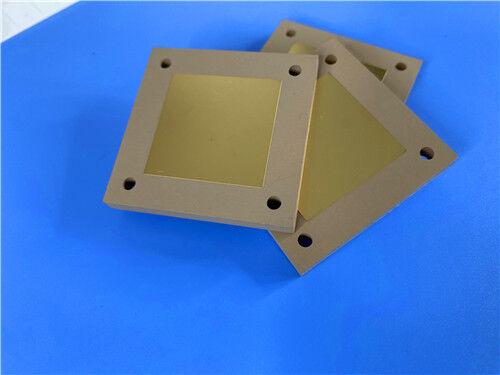
In high-frequency circuit design, achieving the right balance between electrical performance, mechanical reliability, and manufacturability is often challenging. Rogers TMM6—part of the TMM® (Thermoset Microwave Materials) family—addresses this challenge by combining many of the desirable features of ceramic substrates with the ease of soft substrate processing techniques.
TMM6 is a ceramic, hydrocarbon, thermoset polymer composite designed for high plated-through-hole (PTH) reliability in stripline and microstrip applications. With a dielectric constant of 6.00 ± 0.08 and a low dissipation factor of 0.0023 at 10 GHz, TMM6 offers a unique Dk value that fills an important gap between lower-Dk PTFE materials and higher-Dk ceramic substrates.
Unlike PTFE-based materials, TMM6 is a thermoset resin that does not soften when heated, enabling reliable wire bonding without pad lifting or substrate deformation. Its coefficient of thermal expansion (CTE) closely matched to copper ensures exceptional plated-through-hole reliability, while its thermal conductivity is approximately twice that of traditional PTFE/ceramic laminates, facilitating effective heat removal.
This article provides a comprehensive overview of TMM6 laminate properties, a detailed 2-layer PCB design example, and key sourcing information for engineers and procurement professionals.
![]()
What Is Rogers TMM6 Laminate?
Rogers TMM6 is a thermoset microwave material from the TMM series, which includes a wide range of dielectric constants from 3.0 to 10.0. TMM6, with a Dk of 6.0, is specifically designed for applications requiring a higher dielectric constant than traditional PTFE materials but without the brittleness or processing challenges of pure ceramic substrates.
Key Differentiator: Thermoset Resin with Ceramic-Like Performance
TMM6 offers several unique advantages over both PTFE-based and ceramic substrates:
| Feature | TMM6 Advantage |
| Thermoset resin | Does not soften when heated; reliable wire bonding; no pad lifting |
| Ceramic-like electrical performance | High Dk, low loss, stable properties across temperature and frequency |
| No PTFE processing issues | No sodium napthanate treatment required for electroless plating |
| CTE matched to copper | Excellent PTH reliability; low etch shrinkage |
| High thermal conductivity (0.72 W/m·K) | Efficient heat removal; approximately twice that of traditional PTFE/ceramic laminates |
| Isotropic CTE | Consistent expansion in all directions; reduces stress on plated holes |
| Chemical resistance | Resistant to etchants and solvents used in PCB production |
| All common PWB processes | No specialized fabrication techniques required |
Complete Material Properties Table
The following table consolidates all electrical, thermal, mechanical, and physical properties of TMM6 laminates into a single comprehensive reference.
| Property | Typical Value | Direction | Units | Conditions | Test Method |
| Electrical Properties | |||||
| Dielectric Constant, εr (Process) | 6.00 ± 0.080 | Z | – | 10 GHz | IPC-TM-650 2.5.5.5 |
| Dielectric Constant, εr (Design) | 6.3 | Z | – | 8 GHz – 40 GHz | Differential Phase Length Method² |
| Dissipation Factor, tan δ (Process) | 0.0023 | Z | – | 10 GHz | IPC-TM-650 2.5.5.5 |
| Thermal Coefficient of Dk (TCDk) | -11 | – | ppm/°K | -55°C to +125°C | IPC-TM-650 2.5.5.5 |
| Insulation Resistance | >2000 | – | GΩ | C/96/60/95 | ASTM D257 |
| Volume Resistivity | 1 × 10⁸ | – | MΩ·cm | – | ASTM D257 |
| Surface Resistivity | 1 × 10⁹ | – | MΩ | – | ASTM D257 |
| Electrical Strength (Dielectric Strength) | 362 | Z | V/mil | – | IPC-TM-650 2.5.6.2 |
| Thermal Properties | |||||
| Decomposition Temperature (Td) | 425 | – | °C (TGA) | – | ASTM D3850 |
| Coefficient of Thermal Expansion (CTE) | 18 | X | ppm/K | 0°C to 140°C | ASTM E 831 / IPC-TM-650 2.4.41 |
| 18 | Y | ppm/K | 0°C to 140°C | ASTM E 831 / IPC-TM-650 2.4.41 | |
| 26 | Z | ppm/K | 0°C to 140°C | ASTM E 831 / IPC-TM-650 2.4.41 | |
| Thermal Conductivity | 0.72 | Z | W/m/K | 80°C | ASTM C518 |
| Specific Heat Capacity | 0.78 | – | J/g/K | A | Calculated |
| Mechanical Properties | |||||
| Copper Peel Strength (after thermal stress) | 5.7 (1.0) | X,Y | lb/in (N/mm) | After solder float, 1 oz EDC | IPC-TM-650 2.4.8 |
| Flexural Strength (MD/CMD) | 15.02 | X,Y | kpsi | A | ASTM D790 |
| Flexural Modulus (MD/CMD) | 1.75 | X,Y | Mpsi | A | ASTM D790 |
| Physical & Environmental Properties | |||||
| Moisture Absorption | 0.06 | – | % | D/24/23, 1.27mm (0.050") | ASTM D570 |
| 0.2 | – | % | D/24/23, 3.18mm (0.125") | ASTM D570 | |
| Specific Gravity (Density) | 2.37 | – | g/cm³ | A | ASTM D792 |
| Lead-Free Process Compatible | Yes | – | – | – | – |
Notes:
1. Prolonged exposure in an oxidative environment may cause changes to dielectric properties of hydrocarbon-based materials. Rogers recommends evaluating each material and design combination for fitness over the entire product life.
2. The design Dk is an average from multiple tested lots on the most common thicknesses. Contact Rogers for detailed information.
Typical values are a representation of an average value for the population of the property. For specification values contact Rogers Corporation.
Features and Benefits Summary
| Feature | Benefit |
| Dk of 6.00 ± 0.08 | Tight tolerance; predictable impedance control; unique Dk value for specific applications |
| Low Df of 0.0023 @ 10 GHz | Low signal loss for RF and microwave applications |
| TCDk of -11 ppm/°K | Exceptionally stable Dk across temperature; excellent phase stability |
| CTE matched to copper (18/18/26 ppm/K) | High PTH reliability; low etch shrinkage; reduced thermal stress |
| Thermoset resin | No softening when heated; reliable wire bonding; no pad lifting |
| Thermal conductivity of 0.72 W/m/K | Efficient heat removal; approximately 2× better than traditional PTFE/ceramic laminates |
| No PTFE processing issues | No sodium napthanate treatment required for electroless plating |
| Chemical resistance | Resists etchants and solvents; reduces fabrication damage |
| Isotropic CTE | Consistent expansion in all directions |
| Wide thickness range | Available from 0.015" to 0.500" in 0.0015" increments |
| All common PWB processes | No specialized production techniques required |
Exceptional Thermal Stability
TMM6 exhibits a thermal coefficient of dielectric constant (TCDk) of only -11 ppm/°K—exceptionally low for a Dk 6.0 material. This ensures that the dielectric constant remains stable across a wide temperature range (-55°C to +125°C), critical for applications operating in extreme environments such as satellite communications and aerospace systems.
Copper-Matched CTE for PTH Reliability
TMM6's CTE values (18/18/26 ppm/K in X/Y/Z) are closely matched to copper (17 ppm/°C). This match minimizes thermal stress on plated-through-holes during temperature cycling, resulting in:
High PTH reliability – Excellent performance in thermal shock applications
Low etch shrinkage – Dimensional stability during fabrication
Reduced pad lifting – Reliable soldering and wire bonding
High Thermal Conductivity
With a thermal conductivity of 0.72 W/m/K, TMM6 offers approximately twice the thermal conductivity of traditional PTFE/ceramic laminates (typically 0.26–0.35 W/m/K). This facilitates efficient heat removal from power amplifiers and other high-power RF circuits, extending component life and improving reliability.
Thermoset Advantages Over PTFE
Unlike PTFE-based materials, TMM6's thermoset resin:
Does not soften when heated – Enables wire bonding without pad lifting
Does not require sodium napthanate treatment – Simplifies electroless plating
Resists creep and cold flow – Maintains dimensional stability under mechanical stress
Offers consistent performance across processing temperatures
Standard Offerings
TMM6 laminates are available in a comprehensive range of thicknesses, panel sizes, and copper cladding options.
| Thickness (Inches) | Thickness (mm) | Tolerance |
| 0.015" | 0.381 mm | ± 0.0015" |
| 0.025" | 0.635 mm | ± 0.0015" |
| 0.030" | 0.762 mm | ± 0.0015" |
| 0.050" | 1.270 mm | ± 0.0015" |
| 0.060" | 1.524 mm | ± 0.0015" |
| 0.075" | 1.900 mm | ± 0.0015" |
| 0.100" | 2.500 mm | ± 0.0015" |
| 0.125" | 3.175 mm | ± 0.0015" |
| 0.150" | 3.810 mm | ± 0.0015" |
| 0.200" | 5.080 mm | ± 0.0015" |
| 0.250" | 6.350 mm | ± 0.0015" |
| 0.500" | 12.70 mm | ± 0.0015" |
Standard Panel Sizes & Claddings
| Parameter | Options |
| Standard Panel Sizes | 18" × 12" (457 × 305 mm) |
| 18" × 24" (457 × 610 mm) | |
| Additional panel sizes available | |
| Standard Claddings | Electrodeposited Copper (EDC): |
| • ½ oz. (18 μm) HH/HH | |
| • 1 oz. (35 μm) *H1/H1* | |
| Additional Options | Heavy metal cladding, unclad, direct bonding to brass or aluminum plates |
2-Layer PCB Design Example Using TMM6
To demonstrate the practical application of TMM6, the following is a complete 2-layer rigid PCB design case.
![]()
PCB Design Specifications
| Parameter | Specification |
| Base Material | Rogers TMM6 |
| Layer Count | 2-layer rigid |
| Board Dimensions | 85.60 mm × 99.75 mm per panel, ±0.15 mm |
| Minimum Trace/Space | 4 / 6 mils |
| Minimum Hole Size | 0.35 mm |
| Blind/Buried Vias | None |
| Finished Cu Weight | 1 oz (35 μm) all layers |
| Via Plating Thickness | 20 μm |
| Surface Finish | EPIG (Electroless Palladium Immersion Gold – Nickel Free) |
| Top Silkscreen | None |
| Bottom Silkscreen | None |
| Top Solder Mask | None |
| Bottom Solder Mask | None |
| Electrical Testing | 100% prior to shipment |
| Artwork Format | Gerber RS-274-X |
| Accepted Standard | IPC-Class-2 |
| Service Area | Worldwide |
Design Observations
This board (85.6 mm × 99.75 mm) features a moderate component count (23 components) with only 2 nets, suggesting a dedicated RF or microwave functional module. Key observations include:
50 mil (1.27 mm) dielectric thickness – Provides robust mechanical strength and reliable impedance control for microwave circuits
EPIG surface finish (Nickel-Free) – Electroless Palladium Immersion Gold finish offers excellent wire bondability and solderability without nickel, which can be problematic for some RF applications (no magnetic/nickel interference)
No solder mask – Preserves the thermoset material's low-loss characteristics; avoids unwanted dielectric effects
No silkscreen – Maintains a clean RF surface; avoids contamination
TMM6's Dk of 6.0 – Enables circuit miniaturization compared to lower-Dk materials; compact filter and coupler designs
TMM6's thermoset properties – Reliable wire bonding and PTH reliability
IPC-Class-2 compliance – Ensures reliability for commercial and industrial applications
Manufacturing Process Highlights
No specialized processing – TMM6 can be fabricated using all common PWB processes; no sodium napthanate treatment required
Chemical resistance – Resistant to etchants and solvents used in PCB production
Excellent PTH reliability – CTE matched to copper ensures reliable plated-through-holes
Fine-pitch capability – 4/6 mil trace/spacing supports high-density RF designs
100% electrical testing – Guarantees functional integrity of every board
Typical Applications
- RF and microwave circuitry
- Power amplifiers and combiners
- Filters and coupler
- Satellite communication systems
- Global Positioning Systems Antennas
- Patch Antennas
- Dielectric polarizers and lenses
- Chip testers
Conclusion
Rogers TMM6 laminates offer a compelling combination of high dielectric constant (6.00 ± 0.08), low loss (0.0023 @ 10 GHz), and exceptional thermoset reliability—all without the specialized processing requirements of PTFE-based materials. With CTE matched to copper (18/18/26 ppm/K), thermal conductivity of 0.72 W/m·K, and a thermoset resin that enables reliable wire bonding, TMM6 is ideally suited for demanding RF and microwave applications.
Key advantages include:
High Dk of 6.00 – Enables circuit miniaturization compared to lower-Dk materials
Low loss (Df = 0.0023) – Maintains signal integrity in microwave circuits
Thermoset resin – No softening when heated; reliable wire bonding; no pad lifting
CTE matched to copper – Excellent PTH reliability; low etch shrinkage
High thermal conductivity (0.72 W/m·K) – Efficient heat removal; approximately 2× better than PTFE/ceramic laminates
No PTFE processing – No sodium napthanate treatment required; all common PWB processes
Wide thickness range – Available from 0.015" to 0.500"
TCDk of -11 ppm/°K – Exceptionally stable Dk across temperature
Chemical resistance – Resistant to etchants and solvents
Whether used in power amplifiers, satellite communications systems, or microwave test equipment, TMM6 provides a reliable, high-performance foundation for demanding high-frequency circuit designs.
| MOQ: | 1PCS |
| Price: | 2.99USD/pcs |
| Standard Packaging: | Packing |
| Delivery Period: | 8 working days |
| Payment Method: | T/T, Paypal |
| Supply Capacity: | 50000pcs |
Introduction
In high-frequency circuit design, achieving the right balance between electrical performance, mechanical reliability, and manufacturability is often challenging. Rogers TMM6—part of the TMM® (Thermoset Microwave Materials) family—addresses this challenge by combining many of the desirable features of ceramic substrates with the ease of soft substrate processing techniques.
TMM6 is a ceramic, hydrocarbon, thermoset polymer composite designed for high plated-through-hole (PTH) reliability in stripline and microstrip applications. With a dielectric constant of 6.00 ± 0.08 and a low dissipation factor of 0.0023 at 10 GHz, TMM6 offers a unique Dk value that fills an important gap between lower-Dk PTFE materials and higher-Dk ceramic substrates.
Unlike PTFE-based materials, TMM6 is a thermoset resin that does not soften when heated, enabling reliable wire bonding without pad lifting or substrate deformation. Its coefficient of thermal expansion (CTE) closely matched to copper ensures exceptional plated-through-hole reliability, while its thermal conductivity is approximately twice that of traditional PTFE/ceramic laminates, facilitating effective heat removal.
This article provides a comprehensive overview of TMM6 laminate properties, a detailed 2-layer PCB design example, and key sourcing information for engineers and procurement professionals.
![]()
What Is Rogers TMM6 Laminate?
Rogers TMM6 is a thermoset microwave material from the TMM series, which includes a wide range of dielectric constants from 3.0 to 10.0. TMM6, with a Dk of 6.0, is specifically designed for applications requiring a higher dielectric constant than traditional PTFE materials but without the brittleness or processing challenges of pure ceramic substrates.
Key Differentiator: Thermoset Resin with Ceramic-Like Performance
TMM6 offers several unique advantages over both PTFE-based and ceramic substrates:
| Feature | TMM6 Advantage |
| Thermoset resin | Does not soften when heated; reliable wire bonding; no pad lifting |
| Ceramic-like electrical performance | High Dk, low loss, stable properties across temperature and frequency |
| No PTFE processing issues | No sodium napthanate treatment required for electroless plating |
| CTE matched to copper | Excellent PTH reliability; low etch shrinkage |
| High thermal conductivity (0.72 W/m·K) | Efficient heat removal; approximately twice that of traditional PTFE/ceramic laminates |
| Isotropic CTE | Consistent expansion in all directions; reduces stress on plated holes |
| Chemical resistance | Resistant to etchants and solvents used in PCB production |
| All common PWB processes | No specialized fabrication techniques required |
Complete Material Properties Table
The following table consolidates all electrical, thermal, mechanical, and physical properties of TMM6 laminates into a single comprehensive reference.
| Property | Typical Value | Direction | Units | Conditions | Test Method |
| Electrical Properties | |||||
| Dielectric Constant, εr (Process) | 6.00 ± 0.080 | Z | – | 10 GHz | IPC-TM-650 2.5.5.5 |
| Dielectric Constant, εr (Design) | 6.3 | Z | – | 8 GHz – 40 GHz | Differential Phase Length Method² |
| Dissipation Factor, tan δ (Process) | 0.0023 | Z | – | 10 GHz | IPC-TM-650 2.5.5.5 |
| Thermal Coefficient of Dk (TCDk) | -11 | – | ppm/°K | -55°C to +125°C | IPC-TM-650 2.5.5.5 |
| Insulation Resistance | >2000 | – | GΩ | C/96/60/95 | ASTM D257 |
| Volume Resistivity | 1 × 10⁸ | – | MΩ·cm | – | ASTM D257 |
| Surface Resistivity | 1 × 10⁹ | – | MΩ | – | ASTM D257 |
| Electrical Strength (Dielectric Strength) | 362 | Z | V/mil | – | IPC-TM-650 2.5.6.2 |
| Thermal Properties | |||||
| Decomposition Temperature (Td) | 425 | – | °C (TGA) | – | ASTM D3850 |
| Coefficient of Thermal Expansion (CTE) | 18 | X | ppm/K | 0°C to 140°C | ASTM E 831 / IPC-TM-650 2.4.41 |
| 18 | Y | ppm/K | 0°C to 140°C | ASTM E 831 / IPC-TM-650 2.4.41 | |
| 26 | Z | ppm/K | 0°C to 140°C | ASTM E 831 / IPC-TM-650 2.4.41 | |
| Thermal Conductivity | 0.72 | Z | W/m/K | 80°C | ASTM C518 |
| Specific Heat Capacity | 0.78 | – | J/g/K | A | Calculated |
| Mechanical Properties | |||||
| Copper Peel Strength (after thermal stress) | 5.7 (1.0) | X,Y | lb/in (N/mm) | After solder float, 1 oz EDC | IPC-TM-650 2.4.8 |
| Flexural Strength (MD/CMD) | 15.02 | X,Y | kpsi | A | ASTM D790 |
| Flexural Modulus (MD/CMD) | 1.75 | X,Y | Mpsi | A | ASTM D790 |
| Physical & Environmental Properties | |||||
| Moisture Absorption | 0.06 | – | % | D/24/23, 1.27mm (0.050") | ASTM D570 |
| 0.2 | – | % | D/24/23, 3.18mm (0.125") | ASTM D570 | |
| Specific Gravity (Density) | 2.37 | – | g/cm³ | A | ASTM D792 |
| Lead-Free Process Compatible | Yes | – | – | – | – |
Notes:
1. Prolonged exposure in an oxidative environment may cause changes to dielectric properties of hydrocarbon-based materials. Rogers recommends evaluating each material and design combination for fitness over the entire product life.
2. The design Dk is an average from multiple tested lots on the most common thicknesses. Contact Rogers for detailed information.
Typical values are a representation of an average value for the population of the property. For specification values contact Rogers Corporation.
Features and Benefits Summary
| Feature | Benefit |
| Dk of 6.00 ± 0.08 | Tight tolerance; predictable impedance control; unique Dk value for specific applications |
| Low Df of 0.0023 @ 10 GHz | Low signal loss for RF and microwave applications |
| TCDk of -11 ppm/°K | Exceptionally stable Dk across temperature; excellent phase stability |
| CTE matched to copper (18/18/26 ppm/K) | High PTH reliability; low etch shrinkage; reduced thermal stress |
| Thermoset resin | No softening when heated; reliable wire bonding; no pad lifting |
| Thermal conductivity of 0.72 W/m/K | Efficient heat removal; approximately 2× better than traditional PTFE/ceramic laminates |
| No PTFE processing issues | No sodium napthanate treatment required for electroless plating |
| Chemical resistance | Resists etchants and solvents; reduces fabrication damage |
| Isotropic CTE | Consistent expansion in all directions |
| Wide thickness range | Available from 0.015" to 0.500" in 0.0015" increments |
| All common PWB processes | No specialized production techniques required |
Exceptional Thermal Stability
TMM6 exhibits a thermal coefficient of dielectric constant (TCDk) of only -11 ppm/°K—exceptionally low for a Dk 6.0 material. This ensures that the dielectric constant remains stable across a wide temperature range (-55°C to +125°C), critical for applications operating in extreme environments such as satellite communications and aerospace systems.
Copper-Matched CTE for PTH Reliability
TMM6's CTE values (18/18/26 ppm/K in X/Y/Z) are closely matched to copper (17 ppm/°C). This match minimizes thermal stress on plated-through-holes during temperature cycling, resulting in:
High PTH reliability – Excellent performance in thermal shock applications
Low etch shrinkage – Dimensional stability during fabrication
Reduced pad lifting – Reliable soldering and wire bonding
High Thermal Conductivity
With a thermal conductivity of 0.72 W/m/K, TMM6 offers approximately twice the thermal conductivity of traditional PTFE/ceramic laminates (typically 0.26–0.35 W/m/K). This facilitates efficient heat removal from power amplifiers and other high-power RF circuits, extending component life and improving reliability.
Thermoset Advantages Over PTFE
Unlike PTFE-based materials, TMM6's thermoset resin:
Does not soften when heated – Enables wire bonding without pad lifting
Does not require sodium napthanate treatment – Simplifies electroless plating
Resists creep and cold flow – Maintains dimensional stability under mechanical stress
Offers consistent performance across processing temperatures
Standard Offerings
TMM6 laminates are available in a comprehensive range of thicknesses, panel sizes, and copper cladding options.
| Thickness (Inches) | Thickness (mm) | Tolerance |
| 0.015" | 0.381 mm | ± 0.0015" |
| 0.025" | 0.635 mm | ± 0.0015" |
| 0.030" | 0.762 mm | ± 0.0015" |
| 0.050" | 1.270 mm | ± 0.0015" |
| 0.060" | 1.524 mm | ± 0.0015" |
| 0.075" | 1.900 mm | ± 0.0015" |
| 0.100" | 2.500 mm | ± 0.0015" |
| 0.125" | 3.175 mm | ± 0.0015" |
| 0.150" | 3.810 mm | ± 0.0015" |
| 0.200" | 5.080 mm | ± 0.0015" |
| 0.250" | 6.350 mm | ± 0.0015" |
| 0.500" | 12.70 mm | ± 0.0015" |
Standard Panel Sizes & Claddings
| Parameter | Options |
| Standard Panel Sizes | 18" × 12" (457 × 305 mm) |
| 18" × 24" (457 × 610 mm) | |
| Additional panel sizes available | |
| Standard Claddings | Electrodeposited Copper (EDC): |
| • ½ oz. (18 μm) HH/HH | |
| • 1 oz. (35 μm) *H1/H1* | |
| Additional Options | Heavy metal cladding, unclad, direct bonding to brass or aluminum plates |
2-Layer PCB Design Example Using TMM6
To demonstrate the practical application of TMM6, the following is a complete 2-layer rigid PCB design case.
![]()
PCB Design Specifications
| Parameter | Specification |
| Base Material | Rogers TMM6 |
| Layer Count | 2-layer rigid |
| Board Dimensions | 85.60 mm × 99.75 mm per panel, ±0.15 mm |
| Minimum Trace/Space | 4 / 6 mils |
| Minimum Hole Size | 0.35 mm |
| Blind/Buried Vias | None |
| Finished Cu Weight | 1 oz (35 μm) all layers |
| Via Plating Thickness | 20 μm |
| Surface Finish | EPIG (Electroless Palladium Immersion Gold – Nickel Free) |
| Top Silkscreen | None |
| Bottom Silkscreen | None |
| Top Solder Mask | None |
| Bottom Solder Mask | None |
| Electrical Testing | 100% prior to shipment |
| Artwork Format | Gerber RS-274-X |
| Accepted Standard | IPC-Class-2 |
| Service Area | Worldwide |
Design Observations
This board (85.6 mm × 99.75 mm) features a moderate component count (23 components) with only 2 nets, suggesting a dedicated RF or microwave functional module. Key observations include:
50 mil (1.27 mm) dielectric thickness – Provides robust mechanical strength and reliable impedance control for microwave circuits
EPIG surface finish (Nickel-Free) – Electroless Palladium Immersion Gold finish offers excellent wire bondability and solderability without nickel, which can be problematic for some RF applications (no magnetic/nickel interference)
No solder mask – Preserves the thermoset material's low-loss characteristics; avoids unwanted dielectric effects
No silkscreen – Maintains a clean RF surface; avoids contamination
TMM6's Dk of 6.0 – Enables circuit miniaturization compared to lower-Dk materials; compact filter and coupler designs
TMM6's thermoset properties – Reliable wire bonding and PTH reliability
IPC-Class-2 compliance – Ensures reliability for commercial and industrial applications
Manufacturing Process Highlights
No specialized processing – TMM6 can be fabricated using all common PWB processes; no sodium napthanate treatment required
Chemical resistance – Resistant to etchants and solvents used in PCB production
Excellent PTH reliability – CTE matched to copper ensures reliable plated-through-holes
Fine-pitch capability – 4/6 mil trace/spacing supports high-density RF designs
100% electrical testing – Guarantees functional integrity of every board
Typical Applications
- RF and microwave circuitry
- Power amplifiers and combiners
- Filters and coupler
- Satellite communication systems
- Global Positioning Systems Antennas
- Patch Antennas
- Dielectric polarizers and lenses
- Chip testers
Conclusion
Rogers TMM6 laminates offer a compelling combination of high dielectric constant (6.00 ± 0.08), low loss (0.0023 @ 10 GHz), and exceptional thermoset reliability—all without the specialized processing requirements of PTFE-based materials. With CTE matched to copper (18/18/26 ppm/K), thermal conductivity of 0.72 W/m·K, and a thermoset resin that enables reliable wire bonding, TMM6 is ideally suited for demanding RF and microwave applications.
Key advantages include:
High Dk of 6.00 – Enables circuit miniaturization compared to lower-Dk materials
Low loss (Df = 0.0023) – Maintains signal integrity in microwave circuits
Thermoset resin – No softening when heated; reliable wire bonding; no pad lifting
CTE matched to copper – Excellent PTH reliability; low etch shrinkage
High thermal conductivity (0.72 W/m·K) – Efficient heat removal; approximately 2× better than PTFE/ceramic laminates
No PTFE processing – No sodium napthanate treatment required; all common PWB processes
Wide thickness range – Available from 0.015" to 0.500"
TCDk of -11 ppm/°K – Exceptionally stable Dk across temperature
Chemical resistance – Resistant to etchants and solvents
Whether used in power amplifiers, satellite communications systems, or microwave test equipment, TMM6 provides a reliable, high-performance foundation for demanding high-frequency circuit designs.