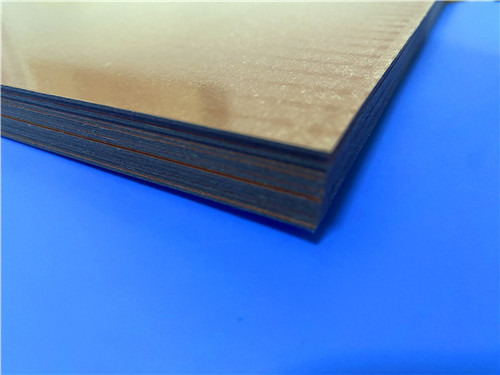
In the demanding world of aerospace and defense electronics, material science is not just an enabler—it is the cornerstone of performance. This case study explores a custom PCB design that pushes the boundaries of high-frequency engineering by leveraging an advanced, ceramic-filled PTFE substrate. The design's minimalist philosophy, featuring no solder mask and no silkscreen, underscores a relentless focus on signal integrity and reliability.
The Brief: A Compact Powerhouse for Critical Applications
This project involved the design and fabrication of a 2-layer rigid printed circuit board with very specific performance targets. The board is compact, measuring 97.53mm x 100.28mm, yet it is built to handle some of the most demanding applications in aerospace, radar, and satellite communications.
Decoding the Bill of Materials: The "Why" Behind the "What"
The specifications reveal a design where every choice is intentional, prioritizing electrical performance above all else.
The Substrate: TFA294 Ceramic-Filled PTFE
The heart of this PCB is the TFA294 dielectric material, a member of the TFA series. This is not a standard PTFE laminate reinforced with glass fiber. Instead, it is a sophisticated composite where PTFE resin is filled with a high volume of uniform, specialized nano-ceramics . This innovative construction method offers several profound advantages.
The most critical benefit is the elimination of the "fiberglass effect." In traditional woven-glass PTFE laminates, the weave of the glass can create microscopic variations in the dielectric constant (Dk). At very high frequencies, these variations can impact phase consistency and signal integrity. By using a homogeneous ceramic-filled system, the TFA series provides exceptional Dk uniformity and minimal X/Y/Z anisotropy. This is critical for sensitive applications like phased array antennas and beamforming networks. Its Dk of 2.94 at 10 GHz and dissipation factor of 0.0010 make it an extremely low-loss material, crucial for minimal signal attenuation in RF and microwave circuits.
A Minimalist Design Philosophy: No Solder Mask, No Silkscreen
The absence of solder mask and silkscreen on both sides of the board is the most visually striking feature. This "bare" approach is a deliberate engineering decision for the highest-frequency designs:
- Ultimate Signal Integrity: Solder mask, while providing protection, is an added dielectric layer with its own loss and impedance characteristics. At microwave frequencies, even these small losses can degrade performance. Removing it ensures the signal interacts only with the high-performance TFA294 substrate and the copper traces, creating a more predictable and low-loss transmission path.
- High-Voltage/Power Capability: The absence of a dielectric layer can also be beneficial in designs with high voltage potentials or high-power RF, where solder mask breakdown could be a concern.
- Simplified Manufacturing for Performance: By omitting these non-functional layers, the fabrication process is streamlined, reducing potential points of failure and focusing entirely on the critical conductor geometry.
Construction and Performance Statistics
The PCB's fabrication details reinforce its precision and performance-oriented design:
- Board Dimensions: 97.53mm x 100.28mm with a tight tolerance of +/- 0.15mm, indicating a requirement for precise mechanical fit and alignment in a larger system.
- Stackup: A 2-layer construction with 35 μm (1 oz) copper on both sides of a 1.016 mm (40 mil) TFA294 core.
- Trace/Space: A fine-pitch minimum of 4/6 mils allows for dense, controlled-impedance routing within the board's area.
- Surface Finish: Immersion Gold (ENIG) provides an excellent, flat, solderable surface for the 14 top-side SMT pads, ensuring reliable solder joints for sensitive components .
- Testing: A 100% electrical test prior to shipment is a mandatory step to guarantee that the careful design and specialized materials translate into a fully functional product.
The Design Decisions: A Closer Look
Examining the component and network structure reveals a focused, high-performance sub-system. The board contains 21 components, a modest number that includes 18 through-hole pads and 14 SMT pads. The presence of 13 vias provides a compact routing solution. The fact that the board has only 2 nets is its most telling feature. This stark simplicity is not a limitation but a direct clue to its application.
A design with only two nets is highly specialized. It is likely a high-power or high-frequency sub-circuit, such as:
- An RF Coupler or Filter: These devices often have very few connections (input, output, and ground).
- A Power Amplifier (PA) Sub-Section: A transistor-based amplifier might have a few DC bias networks but is fundamentally a "2-net" RF path.
- An Antenna Feed Network: A balun or a simple impedance transformer would have a similar structure.
Its acceptance to the IPC-Class-2 standard is significant. While Class-3 is for high-reliability life-support equipment, Class-2 represents a "dedicated service electronic product" with a high level of reliability, which is often the sweet spot for aerospace and defense sub-assemblies where performance and cost-effectiveness are both critical.
Conclusion: A Masterclass in Application-Specific Design
This custom PCB is a perfect example of how material selection, in conjunction with a minimalist design philosophy, delivers unmatched performance for a specific application. By choosing the aerospace-grade TFA294 material, the designer ensured an optimal foundation for high-frequency performance, free from the anomalies of traditional woven-glass materials. The decision to omit solder mask and silkscreen is a testament to the designer's deep understanding of how to minimize parasitic losses and preserve signal fidelity at microwave frequencies.
This board is not a generic product; it is a purpose-built solution designed to excel in the harsh and demanding environment of aerospace and radar systems. It is a small, unassuming component that plays a critical role in the larger, sophisticated systems it serves—a true reflection of the power of purposeful engineering.


 Your message must be between 20-3,000 characters!