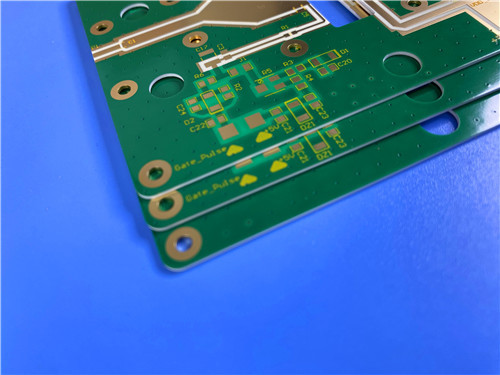
Hi, I'm Sally. Today I'm showcasing a custom PCB built on Wangling WL-CT615—a thermosetting hydrocarbon resin/ceramic material that processes like FR-4 while delivering high-frequency performance.
This custom PCB was fabricated using WL-CT615, an organic polymer ceramic fiberglass laminate with a dielectric constant of 6.15 at 10 GHz. Unlike PTFE materials, it can be processed using standard FR-4 techniques—simplifying manufacturing and improving consistency. With 43 components, 49 vias, and 2 nets, this design is well-suited for base station antennas, automotive radar, and power amplifiers.
Key Takeaways
- Material: WL-CT615 — hydrocarbon resin/ceramic/fiberglass thermoset (Dk 6.15)
- Key Benefit: FR-4-like processability, high Dk for miniaturization, high Tg (>280°C)
- Board Size: 78.03mm x 40.5mm | Finished Thickness: 1.6mm
- Construction: Double-sided, green solder mask on both sides, white silkscreen on top only
- Surface Finish: Immersion Gold
- Design: 43 components, 49 vias, 2 nets — a dense, focused RF circuit
- Quality: IPC-Class-2 was met, and 100% electrical testing was performed

The Challenge: High-Dk Performance with FR-4 Processability
A high-frequency RF board was required by our customer for a demanding application—likely in base station or automotive radar systems. The design needed a high dielectric constant to enable circuit miniaturization, but the customer also wanted the ease and consistency of FR-4 processing. PTFE materials, while excellent electrically, can be more difficult to process and less consistent in circuit definition.
WL-CT615 was selected, a thermosetting resin-based high-frequency material from Wangling. Here's why it was chosen:
FR-4-Compatible Processing
Unlike PTFE materials, WL-CT615 can be processed using techniques similar to FR-4. This simplified manufacturing, reduced cost, and ensured better stability and consistency in circuitry.
High Dielectric Constant (Dk = 6.15 at 10 GHz)
The high Dk enabled circuit miniaturization—an important advantage for compact RF designs.
Low Loss (Df = 0.004 at 10 GHz)
Low loss performance was achieved, meeting the requirements for high-frequency designs.
High Thermal Conductivity (0.72 W/mK)
Effective heat dissipation was provided for power amplifiers and other thermal-sensitive applications.
High Tg (>280°C)
Excellent thermal stability was ensured, with the material maintaining performance at elevated temperatures.
Matched CTE
The CTE was matched to copper in the X-axis (15 ppm/°C) and Y-axis (17 ppm/°C), ensuring reliable plated through-holes.
Low Moisture Absorption (0.04%)
Performance drift in humid environments was prevented.
Domestic Substitute
WL-CT615 serves as a reliable substitute for similar imported products, reducing supply chain risk.
Board Specifications
| Feature |
Specification |
| Dimensions |
78.03mm x 40.5mm (±0.15mm) |
| Stackup |
35μm Cu / 1.524mm WL-CT615 / 35μm Cu |
| Finished Thickness |
1.6mm |
| Trace/Space |
5/7 mils |
| Min Hole Size |
0.35mm |
| Surface Finish |
Immersion Gold |
| Solder Mask |
Green (both sides) |
| Silkscreen |
White (top only) |
| Testing |
100% electrical |
| Standard |
IPC-Class-2 |
Design Statistics
| Metric |
Value |
| Components |
43 |
| Total Pads |
57 (31 through-hole, 26 SMT) |
| Vias |
49 |
| Nets |
2 |
The 2-net design with 49 vias indicates a focused RF circuit with extensive grounding and shielding structures. The high component count (43) suggests a sophisticated sub-system, likely an antenna feed network or power amplifier stage.
Design Choices: Purpose-Built for RF Performance
Green Solder Mask (Both Sides)
Both sides were protected with green solder mask—a departure from the mask-free designs often used in high-frequency applications. This choice provides component protection while maintaining acceptable RF performance for the target frequency range.
White Silkscreen (Top Only)
Clear component identification was provided for assembly and troubleshooting.
Immersion Gold Finish
Immersion gold was chosen to deliver a flat, solderable surface with excellent corrosion resistance.
1.6mm Finished Thickness
The standard 1.6mm thickness provided mechanical robustness for the application.
Material Properties: The Numbers Behind WL-CT615
| Property |
Value |
| Dk @ 10 GHz |
6.15 |
| Df @ 10 GHz |
0.004 |
| TCDK |
-122 ppm/°C |
| Thermal Conductivity |
0.72 W/mK |
| Moisture Absorption |
0.04% |
| CTE (X/Y/Z) |
15/17/33 ppm/°C |
| Tg |
>280°C |
Why This Matters: WL-CT615 offers a high Dk for circuit miniaturization, with the added benefit of FR-4-like processability. Its high Tg and matched CTE ensure reliable performance in demanding thermal environments.
Comparison: How WL-CT615 Stacks Up
| Property |
WL-CT615 |
Standard PTFE |
FR-4 |
| Dk @ 10 GHz |
6.15 |
2.2–3.5 |
4.0–4.5 |
| Df @ 10 GHz |
0.004 |
0.001–0.003 |
0.02–0.03 |
| Processability |
FR-4-like |
Specialized |
Standard |
| Tg |
>280°C |
150–260°C |
130–180°C |
| Thermal Conductivity |
0.72 W/mK |
0.2–0.4 W/mK |
0.3 W/mK |
| Moisture Absorption |
0.04% |
0.02–0.05% |
0.1–0.2% |
Why This Matters: WL-CT615 combines a high Dk with FR-4-like processability—a rare combination that simplifies manufacturing while enabling compact RF designs. Its high Tg and thermal conductivity make it suitable for demanding thermal environments.
Ideal Applications
- Base station antennas and satellite antennas
- Automotive radar, sensors, and navigation systems
- Power amplifiers
- Satellite high-frequency heads
- RF devices and filters
- WiMAX antennas and distributed antennas
Q: What makes WL-CT615 different from PTFE materials?
A: WL-CT615 is a thermosetting hydrocarbon resin/ceramic/fiberglass material that processes like FR-4. This simplifies manufacturing and ensures better stability and consistency in circuitry compared to PTFE.
Q: Why was a high-Dk material chosen?
A: The Dk of 6.15 enables circuit miniaturization—an important advantage for compact RF designs.
Q: Why was green solder mask applied on both sides?
A: Both sides were protected with green solder mask to provide component protection while maintaining acceptable RF performance for the target frequency range.
Q: What is the significance of 49 vias with a 2-net design?
A: The high via count represents extensive grounding and shielding structures, creating a well-defined ground plane for the RF signals.
Q: Is WL-CT615 suitable for automotive applications?
A: Yes. WL-CT615 is well-suited for automotive radar, sensors, and navigation systems, with high thermal conductivity and a high Tg for demanding environments.
Q: Can WL-CT615 replace imported materials?
A: Yes. WL-CT615 was developed as a reliable substitute for similar foreign products, reducing supply chain risk.
Final Thoughts
WL-CT615 delivers high-Dk performance with FR-4-like processability—a unique combination that simplifies manufacturing while enabling compact RF designs. When your application demands miniaturization without the processing challenges of PTFE, this material delivers.
Got a high-Dk or automotive radar project in mind? I'd love to hear about it.


 Your message must be between 20-3,000 characters!