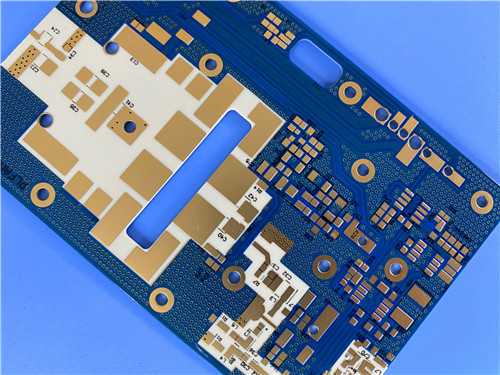
Why the RO4350B LoPro 4mil Immersion Gold PCB is a Game-Changer for RF & High-Speed Designs
Introduction
In the world of high-frequency circuitry, material selection is everything. Standard FR-4 often falls short at gigahertz frequencies, causing excessive signal loss and thermal headaches. Enter the RO4350B LoPro PCB.
We recently got our hands on a specification sheet for a specific 2-layer variant (4mil thick with Immersion Gold finish), and it ticks all the boxes for demanding RF, microwave, and high-speed digital applications. Here is a deep dive into why this particular board—with its 78mm x 101mm footprint—is built to perform.

1. The Core: Rogers RO4350B Low Profile
The hero here is the substrate. Unlike standard RO4350B, this uses Low Profile (LoPro) copper foil technology. Rogers has essentially reverse-treated the foil to bond better with the dielectric. The result? Lower conductor loss, which translates directly to improved insertion loss and signal integrity.
If you are designing circuits above 40 GHz, standard laminates create a bottleneck. The LoPro technology keeps your signal clean and powerful.
Key Stats at 10 GHz/23°C:
Dielectric Constant (Dk): 3.48 ± 0.05 (Stable frequency performance)
Dissipation Factor (Df): 0.0037 (Very low loss)
2. The Build: Ultra-Thin, Ultra-Rugged
At just 0.2mm (4mil) finished thickness, this board is incredibly thin. But don't let its stature fool you; this is a thermally tough board.
Stackup: Copper (35μm) | RO4350B LoPro (0.102mm) | Copper (35μm)
Thermal Conductivity: 0.69 W/mK (Much higher than FR-4, pulling heat away from hot spots efficiently).
High Temperature Stability: Tg > 280°C and Td > 390°C. This board survives lead-free soldering reflow cycles without breaking a sweat.
3. The Finish: Immersion Gold (ENIG)
Why Immersion Gold over HASL or bare copper? For a board this precise, ENIG is mandatory.
Flatness: With a 4mil thickness and fine traces (5/6 mils), you need a perfectly planar surface for soldering small components.
Corrosion Resistance: Gold protects the underlying nickel from oxidation.
Wire Bonding: It allows for aluminum wire bonding if needed.
4. Design & Manufacturing Details
This specific design is a 2-layer rigid board with some tight tolerances that prove the manufacturing capability:
- Minimum Trace/Space: 5/6 mils (Standard for complex RF routing).
- Minimum Hole Size: 0.25mm (Roughly 10mils).
- Vias: 26 vias, 0.25mm minimum, with a 20 μm copper plating thickness. Note the absence of blind vias—this keeps fabrication costs lower while utilizing the full 2-layer stack.
- Solder Mask: Blue on top, none on the bottom.
- Silkscreen: White on top only.
- The Layout Stats:
- 24 Components
- 49 Total Pads (31 Thru-hole, 18 Top SMT)
- 2 Nets (Very clean layout).
5. The "Why": Benefits for Your Application
Why spec this specific board over a standard RF board?
A. Lower Insertion Loss
Because of the LoPro foil and RO4350B dielectric, you can push operating frequencies beyond 40 GHz without the signal attenuation seen in standard materials.
B. Reduced PIM (Passive Inter-modulation)
If you are building base station antennas, PIM is the enemy. The RO4350B system inherently reduces unwanted signal mixing.
C. Thermal Reliability
The Z-axis Coefficient of Thermal Expansion (CTE) is 32 ppm/°C—closely matched to copper (17 ppm/°C). This means your plated through holes won't crack under thermal cycling.
D. Standard FR-4 Processing
Even though this is a high-performance Rogers board, it doesn't require nasty "sodium etch" via preparation. It fabricates using standard epoxy/glass (FR-4) processes, saving you money and lead time.
6. Ideal Applications
Based on the data, this board is built for the intersection of digital and RF:
High-Speed Digital: Servers, routers, and high-speed backplanes (where signal integrity is king).
Telecom Infrastructure: Cellular base station antennas and power amplifiers.
Satellite Systems: LNBs for direct broadcast satellites.
IoT & RFID: RFID tags requiring high frequency accuracy.
The Verdict
The RO4350B LoPro 4mil Immersion Gold PCB is a professional-grade solution for engineers who refuse to compromise. It combines the electrical performance of a high-end RF laminate with the manufacturability of an FR-4 board.
With 100% electrical testing prior to shipment and compliance with IPC-Class-2 standards, this specific 78x101mm board is ready for worldwide deployment.
Need a reliable 2-layer RF board? This is your benchmark.


 Your message must be between 20-3,000 characters!