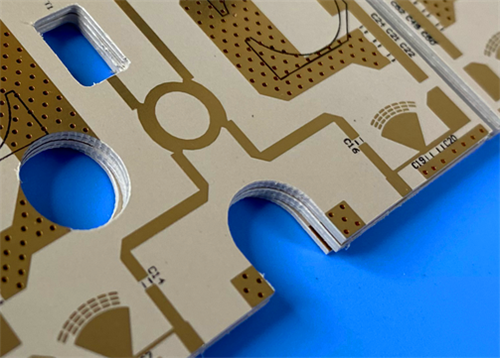
In the world of high-frequency electronics, the mantra is often "less is more." When signal integrity is paramount, every material choice, every design decision, and every manufacturing process must be meticulously scrutinized. This is the story of a fascinating custom PCB project that embodies this principle, leveraging the advanced properties of a specialized substrate to create a robust, high-performance two-layer board.
The Brief: A Foundation for High-Frequency Excellence
This project centered around the design and fabrication of a 2-layer rigid printed circuit board. At its heart lay a specific material: Rogers DiClad 527. This wasn't a standard FR-4 design; it was a board built from the ground up to excel in demanding RF and microwave applications.
Decoding the Bill of Materials: The "Why" Behind the "What"
The specifications of this PCB reveal a clear design philosophy centered on performance, precision, and reliability for high-frequency signals.
The Substrate: Rogers DiClad 527
The most critical choice was the base material. Unlike standard FR-4, DiClad 527 is a PTFE (Teflon) composite reinforced with woven fiberglass. This is a classic material family for high-frequency work because PTFE has inherently low signal loss .
What makes the *527* variant special is its higher ratio of fiberglass reinforcement. This gives it superior dimensional stability compared to some other PTFE materials. Its key properties at 10 GHz are a stable Dielectric Constant (Dk) between 2.40 and 2.60 and an exceptionally low Dissipation Factor (Df) of 0.0017 . For an engineer, this means predictable impedance, minimal signal attenuation, and consistent performance across a wide frequency range.
A Minimalist Design Philosophy: No Solder Mask
One of the most striking features of this PCB is the complete absence of solder mask on both the top and bottom layers. For those used to seeing ubiquitous green (or black, red, blue) boards, this might seem strange. However, it is a deliberate choice for high-frequency designs:
- Signal Integrity: Solder mask has a dielectric constant and a dissipation factor of its own. At high frequencies, this material can become a source of signal loss and impedance variation. By removing it, the signal travels in a more controlled, consistent environment, primarily interacting only with the high-performance DiClad substrate and copper.
- High-Voltage Applications: The absence of a dielectric layer can also be beneficial in designs with high voltage potentials or high-power RF, where solder mask breakdown or arcing could be a concern.
Construction and Performance Statistics
The PCB’s fabrication details further reinforce its performance-oriented design:
- Board Dimensions: 49.63mm x 91.54mm with a tight tolerance of +/- 0.15mm, indicating a need for precise mechanical fit.
- Stackup: A classic 2-layer construction with 35 μm (1 oz) copper on both sides of a 0.508 mm (20 mil) DiClad core.
- Trace/Space: A minimum of 4/6 mils, demonstrating the need for fine-feature routing to accommodate the 36 components and 104 pads within the compact board area .
- Surface Finish: Immersion Gold (ENIG) provides a flat, solderable surface, which is excellent for the 41 top-side SMT pads, and also offers corrosion resistance .
- Testing: A 100% electrical test prior to shipment ensures that the careful design and specialized materials translate into a fully functional product.
The Design Decisions: A Closer Look
Let's examine the component and network structure. The board contains 36 components, 104 total pads (63 of which are through-hole), and 19 vias. This is a mixed-technology design, leveraging the mechanical strength of through-hole components and the density of SMT. The fact that the board has only 2 nets is particularly interesting. This stark simplicity suggests the board is a very specific, potentially high-power or high-frequency sub-circuit—like a filter, a balun, a coupler, or a simple antenna feed network—rather than a complex, multi-function digital board .
The IPC-Class-2 standard acceptance means the board is designed for dedicated service electronic products, a level of reliability that fits this kind of application perfectly.
Conclusion: A Masterclass in Material-Driven Design
This custom PCB is a brilliant example of how material selection drives the entire design process. By choosing Rogers DiClad 527, the designer ensured the board had an optimal foundation for high-frequency performance. The decision to forgo solder mask, a seemingly minor detail, reveals a deep understanding of how parasitic losses can degrade a signal. The precise construction, including the specific copper weight, plating thickness, and tight tolerances, demonstrates a commitment to producing a reliable, high-yield product.
This board isn't just a collection of components on a substrate; it's a testament to the power of purposeful engineering—a device where every material and specification is chosen to fulfill a specific, high-performance mission.


 Your message must be between 20-3,000 characters!